
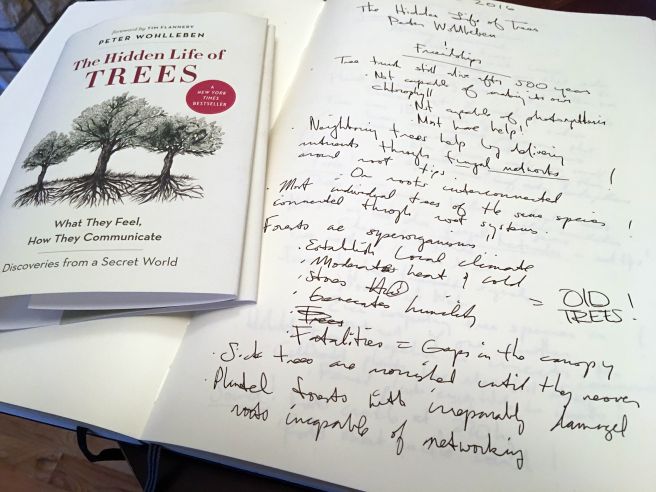
Started reading The Hidden Life of Trees: What They Feel, How They Communicate : Discoveries from a Secret World by Peter Wohlleben foreword by Tim Flannery.
This first post covers the foreword, the two introductions by author Peter Wohlleben, and chapter 1.
Page numbers to notes in parenthesis.
Italics are my questions, comments, and thoughts inspired by the notes.
Questions at the end.
Foreword by Tim Flannery
trees live at a different time scale than people do (vii)
a spruce in Sweden is 9,500 years old (vii)
115 x longer than the human lifespan (vii) just staggering – what else are we not giving respect to because we don’t appreciate it fully in our short lifespans?
electrical impulses move through the roots of trees at 1/3 of an inch per second (vii) what’s our rate of electrical impulses?
trees use taste and smell to communicate (viii)
trees in a forest care for each other (viii)
sometimes nourishing stumps to keep them alive, Flannery speculates that they may be parental trees (viii)
trees stay connected by a ‘wood wide web’ of soil fungi (viii)
trees communicate because they need one another to create a microclimate ‘suitable for growth and sustenance'(viii)
isolated trees have shorter lives than forest trees (viii)
agricultural plants have been ‘rendered deaf and dumb’ (ix)
Introduction to the English Edition
manages a forest in the Eifel mountains in Germany, and is most familiar with beeches and oaks – knowledge can be applied to any forest (x)
example to show ‘how vital undisturbed forests and woodlands are to the future of the planet:’
yellowstone national park – wolves gone in 1920s – entire ecosystem changed:
• elk herds increased numbers
• elk knocked down aspens, willows, and cottonwoods
• ‘animals that depended on the trees left’
• wolves gone for 70 years – when they returned:
• wolf packs kept herds on the move
•trees came back
•roots of cottonwoods and willows ‘stabilized steam banks and slowed the current’
• allowed beavers to return
• wolves…’better stewards of the land than people (xi – xii)
Introduction
when Wohlleben began his career as a forester, he ‘knew about as much about the hidden life of trees as a butcher knows about the emotional life of animals (xiii)
his job to look at trees through the narrow lens of market value (xiii)
only when he began bringing visitors in to the forest for survival training, alternative burial sites, and created an ancient forest preserve, did his perspective shift (xiii)
his visitors opened his eyes to ‘bizarre root shapes, peculiar growth patterns, and mossy cushions on bark,’ his ‘love of Nature…was reignited’ (xiii – xiv)
Aachen University ‘began conducting research in the forest igniting more questions (xiv)
‘when you know that trees experience pain, have memories, and that tree parents live together with their children, you can no longer just chop them down and disrupt their lives with large machines’ (xiv)
started using horses instead – a healthier forest more productive – more profitable (xiv)
Hümmel, in the Eifel mountains ‘will not consider any other way of managing their forest (xiv)
Chapter 1: Friendships
Wohlleben stumbles upon a stump in the forest that is still alive after being felled 500 years ago (2)
no longer capable of photosynthesis, how is it alive? (2)
it must have help (2)
neighboring trees deliver nutrients through fungal networks (2) how?
trees of the same species are connected through their root systems (3)
forests are superorganisms, (3) for trees to survive a long time the forest need to:
• establish local microclimate
• moderate heat and cold
• store water
• generate humidity (4)
when a tree dies it creates a gap in the canopy – to prevent this sick trees are nourished until they recover (4)
planted forests have irreparably damaged roots incapable of networking.
Questions
how do fungal networks communicate?
why are the roots of a planted tree ‘irreparably damaged’?
 backyardbiome.org
21 thoughts on “The Hidden Life of Trees – a foreword, two introductions, and chapter 1”