
Peter Wohlleben’s The Hidden Life of Trees
Page numbers in parentheses. Italics are my own questions of the text.
Chapter 11 Notes Chapter 12 Notes
Chapter 10 Notes Chapter 9 Notes Chapter 8 Notes
Chapter 7 Notes Chapter 6 Notes Chapter 5 Notes
Chapters 3 & 4 Notes Chapter 2 Notes Foreword, Introductions, and Chapter 1 Notes
Chapter 13 – Specialists
once a seed lands, there’s not many transportation opportunities (73)
• once it sprouts, it’s stuck in that spot for life
• trees want:
• nutrient rich loose crumbly soil
• aerated to a depth of many feet (74)
• not too hot in summer
• not too cold in winter
• moderate snowfall
• fall storms moderated by hills or mountain ridges
• not too many fungi in forest
• if all this occurred competition would be won by beeches
when you look at a forest or woods after reading this book you realize every tree out there is a goddamn miracle
• spruce (75)
• can get foothold where summer is short and winter cold
• store oils in needles and bark
• antifreeze
• even with just a few weeks of photosynthesis can grow an inch or two in a year
• holding needles is risky
• snowfall can break a tree
• so it grows a STRAIGHT trunk
• branch angles down as snow falls on them (76)
• most snow falls around not on
• needles present more surface area to wind
• protected by slow rate of growth
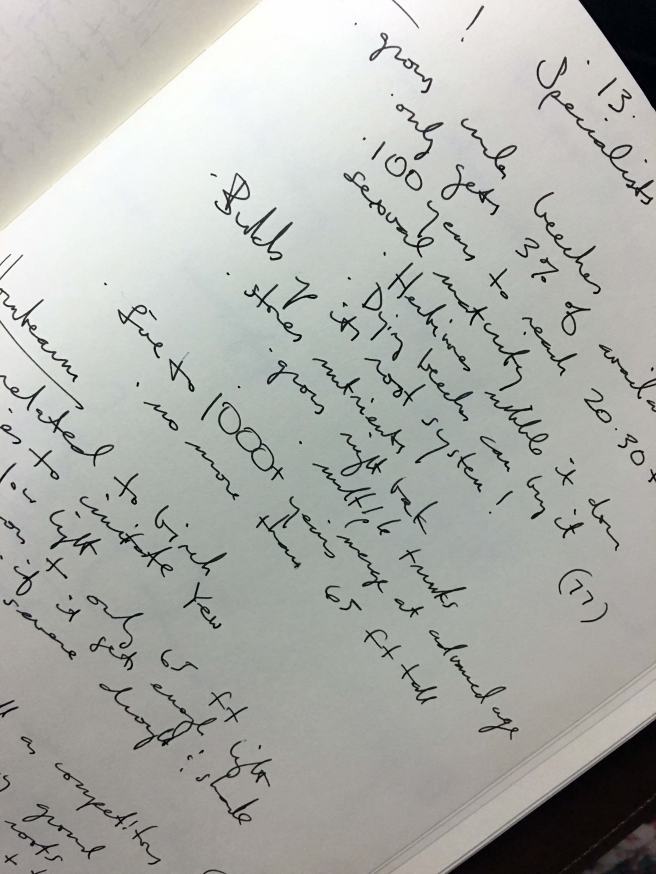
•yew
• grows under beeches
• only gets 3% of available light
• 100 years to reach 20 – 30 feet and sexual maturity
• herbivores nibble them down
• dying beeches can bury it
• builds up its root system (77)
• stores nutrients
• grows right back
• multiple trunks merge at advanced age
• live to 1000+ years
• no more than 65 ft tall
• hornbeam
• related to birch
• tries to imitate yew
• low light
• grows to only 65 ft
• if it gets enough light
• grows in severe drought and shade
• alder
• don’t grow as tall as competitors
• can grow on swampy ground
• air ducts inside roots
• transport oxygen to tiniest tips
• like divers connected to surface via breathing tube
• cork cells in lower trunk
• allow air to enter when underwater
• but after extended period underwater alders can weaken
• fungi eats
 backyardbiome.org
One thought on “reading The Hidden Life of Trees – Chapter 13 – Specialists”