reading The Hidden Life of Trees Chapter 11

hidden-life-of-trees-chapter-11-notes

Peter Wohlleben’s The Hidden Life of Trees

Page numbers in parentheses. Italics are my own questions of the text.

Chapter 10 Notes             Chapter 9 Notes      Chapter 8 Notes

Chapter 7 Notes               Chapter 6 Notes      Chapter 5 Notes

Chapters 3 & 4 Notes      Chapter 2 Notes      Foreword, Introductions, and Chapter 1 Notes

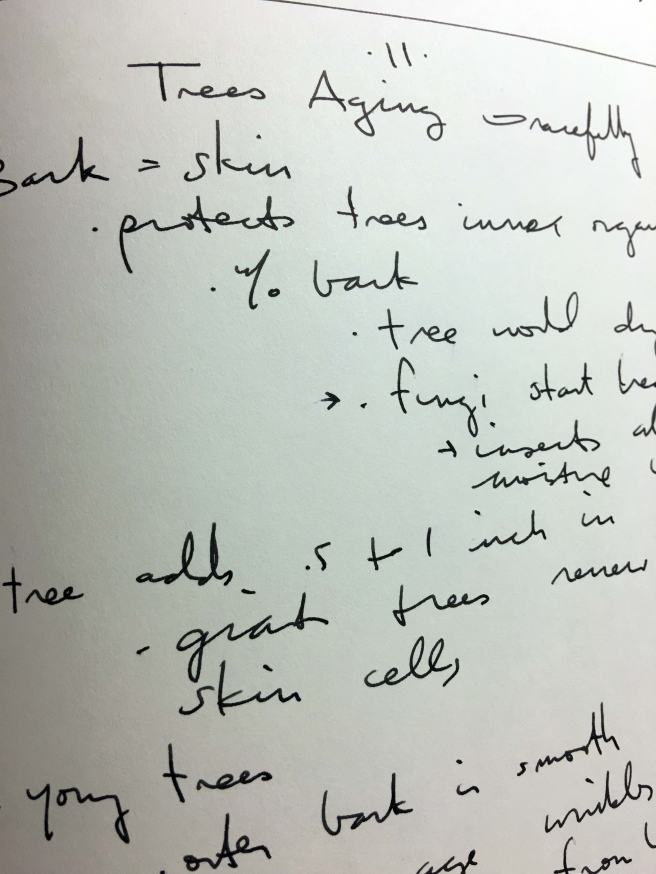
Chapter 11 Trees Aging Gracefully

bark = skin

• protects trees inner organs (61)

• without bark

• tree dries out

• fungi start breaking everything down

• insects also invade with lower moisture levels

tree adds .5 to 1 inch in girth

• trees renew skin and shed skin cells

young trees = smooth outer bark (62)

• as trees age wrinkles appear

• starting from bottom

• deepen over time

beeches

• high renewal rate

• skin thin

• matches girth

• doesn’t crack

pines

• shed slowly

• thick oak bark

• exterior layers decades old (63)

• outer layers originated when tree was young

beeches

• once they start to wrinkle

• mosses colonize nooks and crannies

• estimate tree age by height of green moss

• higher the moss, older the tree

canadian west coast (64)

• ancient growth

• sitka spruce

• 500 years old

• moss in branches and forks

• algae

• capture nitrogen

• rain washes nitrogen down trunk

• nitrogen is a fertilizer

• fertilizes young trees

old age

• after 100 – 300 years (65)

• crown growth gets shorter

• every tree gradually stops getting taller

• energy levels drop

• loses twigs top-down

• fungi advance inward (66)

• consume cellulose and lignin

• trees grows outward to counter

• trunk snaps

reading The Hidden Life of Trees -Chapter 10

hidden-life-of-trees-chapter-10-notes

Peter Wohlleben’s The Hidden Life of Trees

Page numbers in parentheses. Italics are my own questions of the text.

Chapter 9 Notes

Chapter 8 Notes

Chapter 7 Notes

Chapter 6 Notes

Chapter 5 Notes

Chapters 3 & 4 Notes

Chapter 2 Notes

Foreword, Introductions, and Chapter 1 Notes

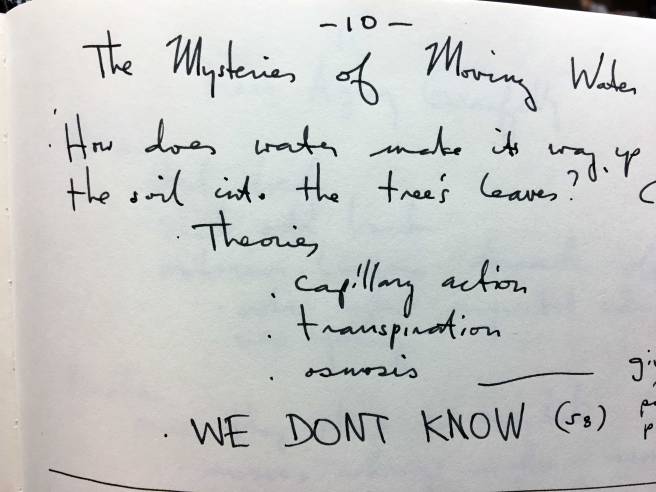
Chapter 10 The Mysteries of Moving Water

how does water make its way up from the soil into the tree’s leaves? (56)

• WE DON’T KNOW (58)

If we don’t know how trees do this one simple task, drink, then what else don’t we know about trees? We don’t even know what we don’t know, and someone places a ‘value’ on the tree? How can we possibly hope for that value to be accurate? If there’s a value in removal, what’s the value in leaving that tree alone? Has anyone calculated that? And if we can’t put a value on it, does that mean we shouldn’t remove it, or at least think long and hard before we do?

• theories

• capillary action

• can only move the water up about three feet

• transpiration

• doesn’t work all the time

• tree has water even when transpiration can’t be the reason

• osmosis (57)


reading The Hidden Life of Trees – Chapter 9

hidden-life-of-trees-chapter-9-notes

Peter Wohlleben’s The Hidden Life of Trees

Page numbers in parentheses. Italics are my own questions of the text.

Chapter 8 Notes

Chapter 7 Notes

Chapter 6 Notes

Chapter 5 Notes

Chapters 3 & 4 Notes

Chapter 2 Notes

Foreword, Introductions, and Chapter 1 Notes

Chapter 9 United We Stand Divided We Fall

different species fight for light and water

• tap into damp ground (49)

• roots grow fine hairs to increase surface are

• suck up as much water as possible

more is better

• trees pair with fungi

• have for millions of years

plants

• create their own food out of inanimate material

animals

• eat other living things (50)

fungi

• cell walls made of chitin

• chitin

• substance never found in plants

• makes fungi more like insects

• cannot photosynthesize

• depend on organic connections with other living beings they can feed on

• mycelium

• fungi underground web

• expands over decades

• oregon fungi

• 2400 years old

• 2000 acres

• 660 tons

trees can suck up more water with the help of mycelium (50 – 51)

• fungal threads grow into/_between_ soft root hairs

• mycelium web expands (51)

• expanding reach of roots!

• fungi demands up to a third of of tree’s total production

fungi grow to be hundreds of years old (52)

• some species host specific

• chantarelles are not however

• oak • birch • spruce

fungi connect across species lines (53)

• trees may fight other species

• fungi connections give strength to the forest

reading The Hidden Life of Trees – Chapter 8

hidden-life-of-trees-chapter-8-notes

Peter Wohlleben’s The Hidden Life of Trees

page numbers in parentheses. italics are my own questions of the text.

Chapter 7 Notes

Chapter 6 Notes

Chapter 5 Notes

Chapters 3 & 4 Notes

Chapter 2 Notes

Foreword, Introductions, and Chapter 1 Notes

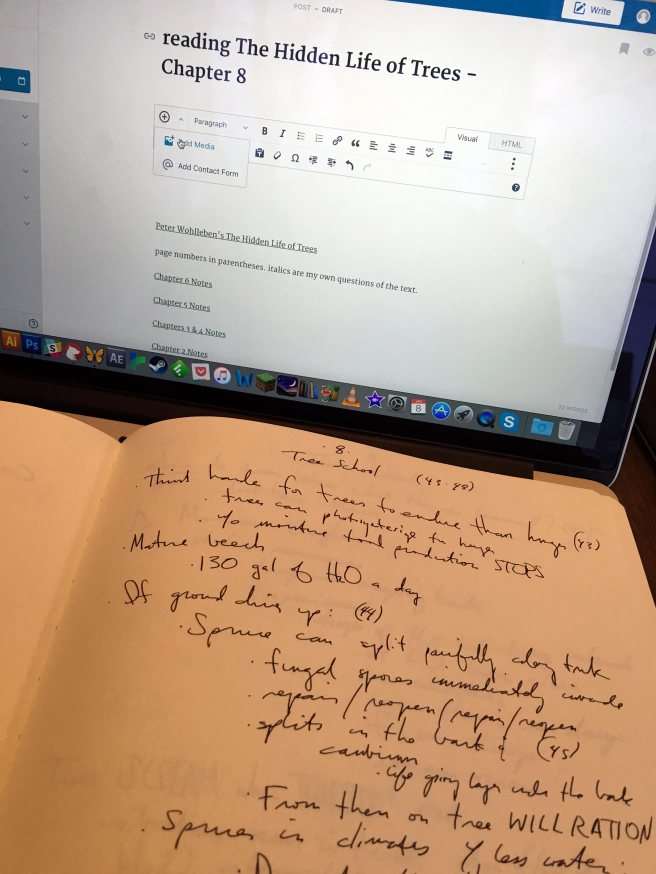
thirst harder for trees to endure than hunger (43)

• trees can photosynthesize when hungry

• without moisture food production STOPS

mature beech

• consumes 130 gal of water a day

if ground dries up

• spruce can split painfully in trunk (44)

• fungal spores immediately invade

• splits in the bark (45)

• repair/reopen/repair/reopen

• cambrium

• life giving layer under the bark

• from then on tree WILL ration

spruces in climates with less water

• do not suffer this way

• slower growth

• ration water

how trees learn to support themselves after loss of neighbor

• micro-tears when bending in the wind (46)

• whatever points hurt that’s where the tree strengthens

• instead of growing

• leaves adapted to low-light

• have to now grow leaves that can handle more light

• takes 2 growing seasons

• conifers take even longer!

• needles stay on branch for up to 10 years

• trees learn, but WHERE do they store what they’ve learned? (47)

• HOW do they store what they’ve learned?

• don’t have brains

• Dr. Monica Gagliano

• studies mimosas

• tropical creeping herb

• experiment:

• drops of water fall on leaves at regular intervals

• first leaves close immediately

• then learn there is no change from drops

• so they remain open!

trees SCREAM when THIRSTY! (48)

• vibrations occur in trunk when flow of water interrupted

• similar to air passing through windpipe in humans (48)

• could be cries of thirst!

reading The Hidden Life of Trees – Chapter 7

hidden-life-of-trees-chapter-7-notes

Peter Wohlleben’s The Hidden Life of Trees

page numbers in parentheses. italics are my own questions of the text.

Chapter 6 Notes

Chapter 5 Notes

Chapters 3 & 4 Notes

Chapter 2 Notes

Foreword, Introductions, and Chapter 1 Notes

Chapter 7 Forest Etiquette

features of a mature well-formed deciduous (37)

• in youth

• narrow branches

• extend away from trunk

• die off

• sealed with new bark

• smooth column

• straight trunk

• regular arrangement of wood fibers

• long and smooth

• roots stretch out evenly in all directions

• reach down into earth under tree

• top

• symmetrical crown

• strong branches

• angling upward

same for conifers except

• topmost branches horizontal (or bent slightly downward)

STABILITY

• windstorm can tear at base of trunk with a force of 220 tons (38)

problematic tree shapes

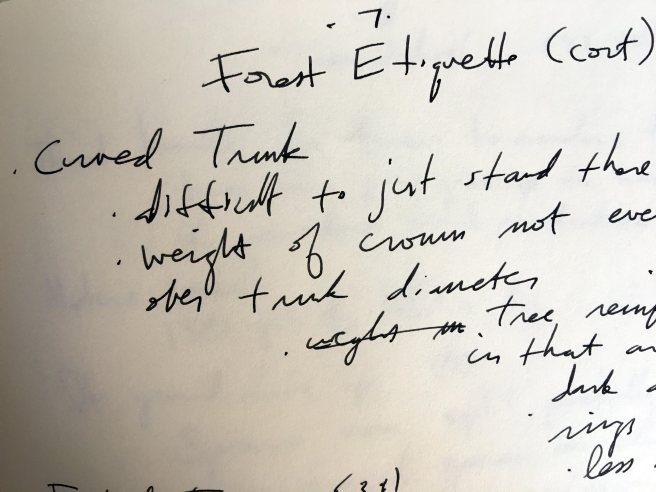
• curved trunk

• difficult to just stand there (38)

• weight of crown not evenly distributed over trunk diameter

• tree reinforces wood in that area

• dark areas in growth rings

• less air and more wood

• forked trees

• each have their own crown

• both swing back and forth in different directions (39)

• U shaped

• tree can make it

• V shaped

• fork breaks at narrowest point

• thick bulges of wood to try and prevent further damage

• bacteria blackened liquid constantly seeps from wood

• water gathers = rot

• banana shaped trunks

• lower part sticks out at an angle (40)

• due to snow or earth slide

trees grow only from the tip (40) what does that mean exactly? tip? tips

conifers grow straight or not at all (41)

• except pines

• crown points towards light

• highest breakage rate due to snow

reading The Hidden Life of Trees – chapter 6

hidden-life-of-trees-chapter-6-notes

Peter Wohlleben’s The Hidden Life of Trees

page numbers in parentheses. italics are my own questions of the text.

Chapter 5 Notes

Chapters 3 & 4 Notes

Chapter 2 Notes

Foreword, Introductions, and Chapter 1 Notes

Chapter 6 Slowly Does It

trees grow slooooooooooow

• beech

• count nodes on branches of young trees (31)

• as the branch gets longer the nodes stay behind

does this method of age determination work with other species as well?

mother trees want slow growth in their children (32)

• slow growth from light deprivation

• slow growth in young trees key to old age

slow growth in natural conditions (33)

• pencil thick trees are 80 – 120 years old

• woody cells are tiny and contain almost no air

• flexible

• resistant to breakage

• resistant to fungi

mothers deliver sugar and nutrients through root systems (34)

if tree is wider than it is tall, it is in waiting mode (34)

• waiting mode

• look like flat-topped bonsai trees (34)

• leaves (or needles) sensitive to low light

• adapted to shade

When the mother tree dies sets off a chain reaction

• falls to ground

• snaps seedlings

• only trees below that grow straight and tall make it

• meandering trees get caught in darkness again

• this darkness even darker

• more photosynthesis

• fruit becomes sweeter (35)

• attracts predatory herbivores

• honeysuckle

• winds its way around saplings

• if canopy closes honeysuckle dies off before killing trees

• neighbors of mother tree close the canopy gap (36)

• once young trees have made it to the middle story

• no longer threatened by competitors

reading The Hidden Life of Trees – Chapter 5

hidden-life-of-trees-chapter-5-notes

Peter Wohlleben’s The Hidden Life of Trees.

Chapter 3 & 4 Notes

Chapter 2 Notes

Foreword, Introductions, and Chapter 1 Notes

Chapter 5 The Tree Lottery

beeches and oaks blossom every 3 – 5 years

• vacate leaves to make room for blossoms (26)

• trees left vulnerable

• nothing left to defend against sickness or insects

• have to endure insect attack without responding (27)

• sick trees don’t produce fewer blossoms

• protect their genetic legacy

• blossom production has more to do with the previous year than the upcoming year (27)

seeds

• beeches and oaks

• seeds fall directly under mother trees

• sprout as quickly as possible (28)

• bird cherries

• pioneer species

• seeds can lie dormant for up to 5 years

only one tree will reach adulthood! (29)

• beeches = 30k beechnuts

• sexually mature @ 80 – 150 years

• live about 400 years

• 60 fruitings over that span

= 1.8 million beechnuts

• poplars

• 54 million seeds every year

• more than a billion seeds in a lifetime (30)

reading The Hidden Life of Trees – Chapters 3 and 4

These are my chapters 3 and 4 notes from Peter Wohlleben’s The Hidden Life of Trees.

Notes Entry 1 – A foreword, two introductions, and chapter 1

Notes Entry 2 – chapter 2

I just realized how boring these last three photos from my notes are. Just photos of a book, my notebook, my pen, and maybe my hand.

If you’d like more exciting images, you could always take a look at my (short) videos.

Onward!

hidden-life-of-trees-chapter-3-notes.JPG

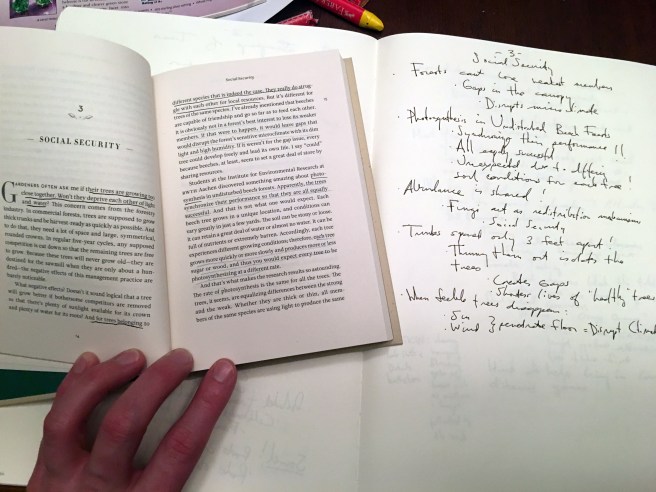
Chapter 3 – Social Security

forests don’t want to lose weakest members (15)

• creates gaps in canopy (15)

• disrupts local climate (15)

photosynthesis in undisturbed beech forests: (15)

• synchronized between trees! (15)

• all equally successful (15)

• UNEXPECTED due to different soil conditions for each tree (15)

abundance is SHARED (16)

• fungi act as redistribution mechanisms (16)

•’social security’ (16)

• thinning trees out ISOLATES them (17)

• creates gaps in communication (17)

• shortens lives of the healthy trees (17)

when feeble trees disappear: (17)

• sun and wind penetrate to forest floor (17)

!disrupts climate! (17)

Chapter 4 – Love

reproduction planned 1 year in advance in deciduous trees (19)

• 3 – 5 years

• deciduous trees decide based on conditions (19)

• so that herbivores can’t count on beech nuts and acorns (19 – 20)

• conifers send out seeds yearly (19)

‘mast year’ (20)

• year when beeches and oaks set seed

• multi year gaps cause herbivores numbers to crash

• helps seedlings sprout

trees that use WIND for pollination (21)

• how to avoid inbreeding (pollinating its own flowers)? (22)

• timing (22)

• male and female blossoms flower a few days apart

• genetic testing! (22 – 23)

• bird cherries block the tube unless there are foreign genes present

• individual genders (23)

• willows osage orange trees?

• males make catkins BRIGHT YELLOW to attract bees there first (24)

• wind also brings in long distance genes (24)

reading The Hidden Life of Trees – Chapter 2

hidden-life-of-trees-chapter-2-notes

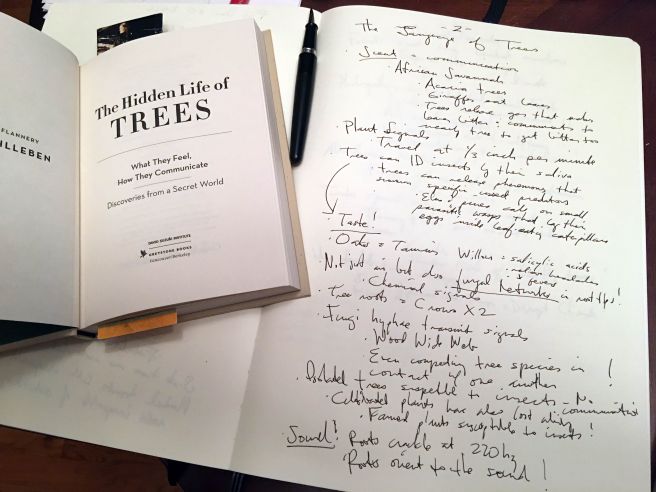
Chapter 2: The Language of Trees

scent = communication (6)

• the african savannah

• acacia trees

• giraffes eat leaves

• trees release gas that makes leaves bitter

• also signals nearby trees to make their own leaves bitter (7)

plant electrical signals travel at 1/3 of an inch per minute (8)

trees can identify insects by the insect’s saliva taste!(9)

• can release pheremones that summon specific insect predators (8)

• elms and pines call on small parasitic wasps that lay their eggs insided leaf-eating caterpillars (8)

oaks release tannins (9)

willows release salicylic acids (9)

• relieve headaches

• reduce fevers

trees also communicate by fungal networks in root tips (10)

tree root size is crown x2+ (10)

fungi hyphae transmit signals (10)

• ‘wood wide web’ (11)

• even competing tree species in contact with one another (11)

isolated trees susceptible to insects (11)

• no communication with other species (11)

cultivated plants have also lost ability to communicate (11)

• farmed plants especially susceptible to insects because they’re ‘deaf and dumb’ (11)

sound! (13)

• roots ‘crackle’ at 220 hz (13)

! root tips orient themselves towards the sound ! (13)

The Hidden Life of Trees – a foreword, two introductions, and chapter 1

hidden-life-of-trees-chapter-1-notes

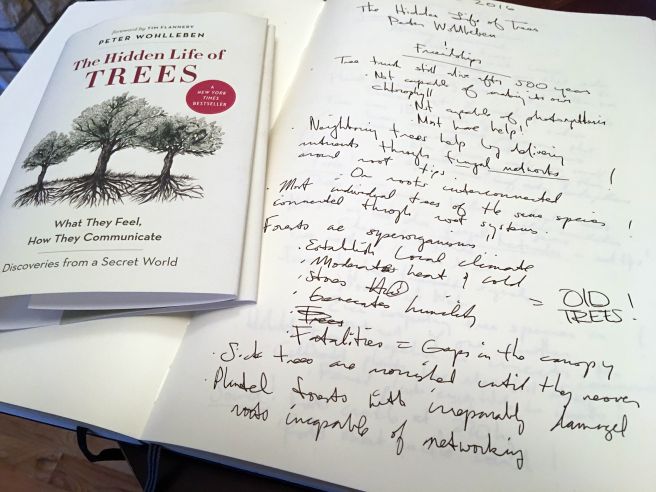
Started reading The Hidden Life of Trees: What They Feel, How They Communicate : Discoveries from a Secret World by Peter Wohlleben foreword by Tim Flannery.

This first post covers the foreword, the two introductions by author Peter Wohlleben, and chapter 1.

Page numbers to notes in parenthesis.

Italics are my questions, comments, and thoughts inspired by the notes.

Questions at the end.

Foreword by Tim Flannery

trees live at a different time scale than people do (vii)

a spruce in Sweden is 9,500 years old (vii)

115 x longer than the human lifespan (vii) just staggering – what else are we not giving respect to because we don’t appreciate it fully in our short lifespans?

electrical impulses move through the roots of trees at 1/3 of an inch per second (vii)  what’s our rate of electrical impulses?

trees use taste and smell to communicate (viii)

trees in a forest care for each other (viii)

sometimes nourishing stumps to keep them alive, Flannery speculates that they may be parental trees (viii)

trees stay connected by a ‘wood wide web’ of soil fungi (viii)

trees communicate because they need one another to create a microclimate ‘suitable for growth and sustenance'(viii)

isolated trees have shorter lives than forest trees (viii)

agricultural plants have been ‘rendered deaf and dumb’ (ix)

Introduction to the English Edition

manages a forest in the Eifel mountains in Germany, and is most familiar with beeches and oaks – knowledge can be applied to any forest (x)

example to show ‘how vital undisturbed forests and woodlands are to the future of the planet:’

yellowstone national park – wolves gone in 1920s – entire ecosystem changed:

• elk herds increased numbers

• elk knocked down aspens, willows, and cottonwoods

• ‘animals that depended on the trees left’

• wolves gone for 70 years – when they returned:

• wolf packs kept herds on the move

•trees came back

•roots of cottonwoods and willows ‘stabilized steam banks and slowed the current’

• allowed beavers to return

• wolves…’better stewards of the land than people (xi – xii)

Introduction

when Wohlleben began his career as a forester,  he ‘knew about as much about the hidden life of trees as a butcher knows about the emotional life of animals (xiii)

his job to look at trees through the narrow lens of market value (xiii)

only when he began bringing visitors in to the forest for survival training, alternative burial sites, and created an ancient forest preserve, did his perspective shift (xiii)

his visitors opened his eyes to ‘bizarre root shapes, peculiar growth patterns, and mossy cushions on bark,’ his ‘love of Nature…was reignited’ (xiii – xiv)

Aachen University ‘began conducting research in the forest igniting more questions (xiv)

‘when you know that trees experience pain, have memories, and that tree parents live together with their children, you can no longer just chop them down and disrupt their lives with large machines’ (xiv)

started using horses instead – a healthier forest more productive – more profitable (xiv)

Hümmel, in the Eifel mountains ‘will not consider any other way of managing their forest (xiv)

Chapter 1: Friendships

Wohlleben stumbles upon a stump in the forest that is still alive after being felled 500 years ago (2)

no longer capable of photosynthesis, how is it alive? (2)

it must have help (2)

neighboring trees deliver nutrients through fungal networks (2)  how?

trees of the same species are connected through their root systems (3)

forests are superorganisms, (3) for trees to survive a long time the forest need to:

• establish local microclimate

• moderate heat and cold

• store water

• generate humidity (4)

when a tree dies it creates a gap in the canopy – to prevent this sick trees are nourished until they recover (4)

planted forests have irreparably damaged roots incapable of networking.

Questions

how do fungal networks communicate?

why are the roots of a planted tree ‘irreparably damaged’?