reading The Hidden Life of Trees – Chapter 15 – In The Realm of Darkness

hidden-life-of-trees-chapter-15-notes

Peter Wohlleben’s The Hidden Life of Trees

Page numbers in parentheses. Italics are my own questions of the text.

Chapter 14 Notes

Chapter 13 Notes             Chapter 12 Notes         Chapter 11 Notes

Chapter 10 Notes             Chapter 9 Notes           Chapter 8 Notes

Chapter 7 Notes               Chapter 6 Notes           Chapter 5 Notes

Chapters 3 & 4 Notes      Chapter 2 Notes      Foreword, Introductions, and Chapter 1 Notes

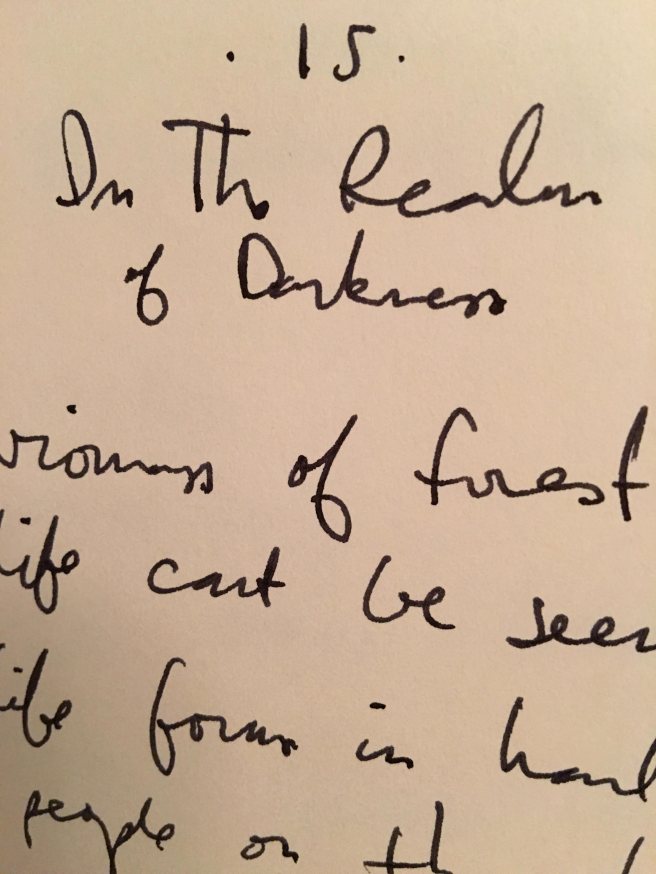
Chapter 15 – In The Realm of Darkness

half of the biomass of forest is in the soil (85)

• most life can not be seen by naked eye

• more life forms in a handful of forest soil than people on the planet (86) is that true?

• teaspoonful contains miles of fungal filaments

when soil first created:

extraordinary to consider that soil is something that is formed over time – not something that just exists. i’m even more dismissive of it when I think of it as simply ‘dirt’. dirt feels dead – but soil feels alive and thriving

• geological processes in ice age

• sub zero temps

• glaciers ground down fragments

• created loosely packed substrate

• bacteria fungi and plants died to form humus

• trees moved in thousands of years later

• stabilized soil with root systems

• humus grows deeper

• early stages of bituminous coal

erosion

• forests left undisturbed

• lose only 1 to 14 tons of soil per square mile annually (87)

• soil becomes deeper and richer

• growing conditions constantly improve

animals

• beetle mites, springtails, pseudocentipedes

• first link in food chain

• terrestrial plankton

• countless species waiting to be discovered

beetles (88)

• oribatid mites

• live off leaves and bark fragments, and fungi

weevils

• ‘tiny elephants’

• most species-rich family of insects in the world (89)

• eat small holes in leaves

• plant eggs

• larvae eat their way out

• some species can no longer fly

• can only travel 30 ft per year at best

• only there if undisturbed forest

• forests cleared in middle ages won’t have them

• starve and die out in altered forests

will there ever be old growth forests again (90)

• bavarian forest (national park)

• microscopic organisms can cover long distances

• (by bird)

• if there are more undisturbed forests, they can make a comeback

Lüneberg Heath (91)

• planted oaks 100 years ago

• still gaps in microscopic species

• need preserves of ancient forests

• like Hümmel (92) with mixed use

• burial sites

• restore longleaf pines in southwest usa how so?

• ancient Caledonian Forests
reading The Hidden Life of Trees – Chapter 14 – Tree or Not Tree?

hidden-life-of-trees-chapter-14-notes

Peter Wohlleben’s The Hidden Life of Trees

Page numbers in parentheses. Italics are my own questions of the text.

Chapter 11 Notes              Chapter 12 Notes    Chapter 13 Notes

Chapter 10 Notes             Chapter 9 Notes      Chapter 8 Notes

Chapter 7 Notes               Chapter 6 Notes      Chapter 5 Notes

Chapters 3 & 4 Notes      Chapter 2 Notes      Foreword, Introductions, and Chapter 1 Notes

Chapter 14 – Tree or Not Tree?

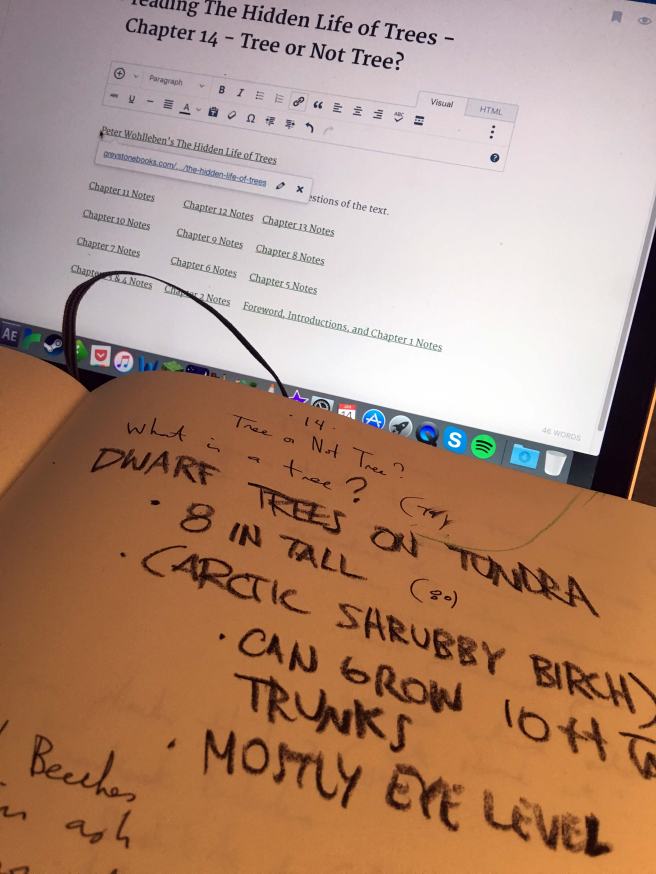
what is a tree? (79)

• dwarf trees on tundra

• 8 inches tall (80)

• (arctic shrubby birch)

• can grow 10 ft tall trunks

• mostly eye level

small beeches, mountain ash

• browsed on by mammals

• grow multiple shoots like bushes

stump?

• new stumps grow out of old stumps

• ‘coppicing’

• trees cut down to base of stump

• new trunks grow from base

• oak and hornbeam

• are those trunks now young trees? (81)

• or are they thousands of years old?

• oldest spruce in Dalarna

• flat shrubby growth around small single trunk

• carbon 14 dating = 9,550 years old!

root regrows trunk time and time again

• roots most important part of tree (82)

• equivalent of brain

• has to store experience somewhere

• most permanent part of tree

• where else would it store information?

can plants think? (83)

• frantisek baluska

• institute of cellular and molecular biology university of bonn

• brain like structure in root tips

• root feels its way through the ground

• aware of stimuli

• toxins

• stones

• saturated soil

reading The Hidden Life of Trees – Chapter 13 – Specialists

hidden-life-of-trees-chapter-13-notes

Peter Wohlleben’s The Hidden Life of Trees

Page numbers in parentheses. Italics are my own questions of the text.

Chapter 11 Notes              Chapter 12 Notes

Chapter 10 Notes             Chapter 9 Notes      Chapter 8 Notes

Chapter 7 Notes               Chapter 6 Notes      Chapter 5 Notes

Chapters 3 & 4 Notes      Chapter 2 Notes      Foreword, Introductions, and Chapter 1 Notes

Chapter 13 – Specialists

once a seed lands, there’s not many transportation opportunities (73)

• once it sprouts, it’s stuck in that spot for life

• trees want:

• nutrient rich loose crumbly soil

• aerated to a depth of many feet (74)

• not too hot in summer

• not too cold in winter

• moderate snowfall

• fall storms moderated by hills or mountain ridges

• not too many fungi in forest

• if all this occurred competition would be won by beeches

when you look at a forest or woods after reading this book you realize every tree out there is a goddamn miracle

• spruce (75)

• can get foothold where summer is short and winter cold

• store oils in needles and bark

• antifreeze

• even with just a few weeks of photosynthesis can grow an inch or two in a year

• holding needles is risky

• snowfall can break a tree

• so it grows a STRAIGHT trunk

• branch angles down as snow falls on them (76)

• most snow falls around not on

• needles present more surface area to wind

• protected by slow rate of growth

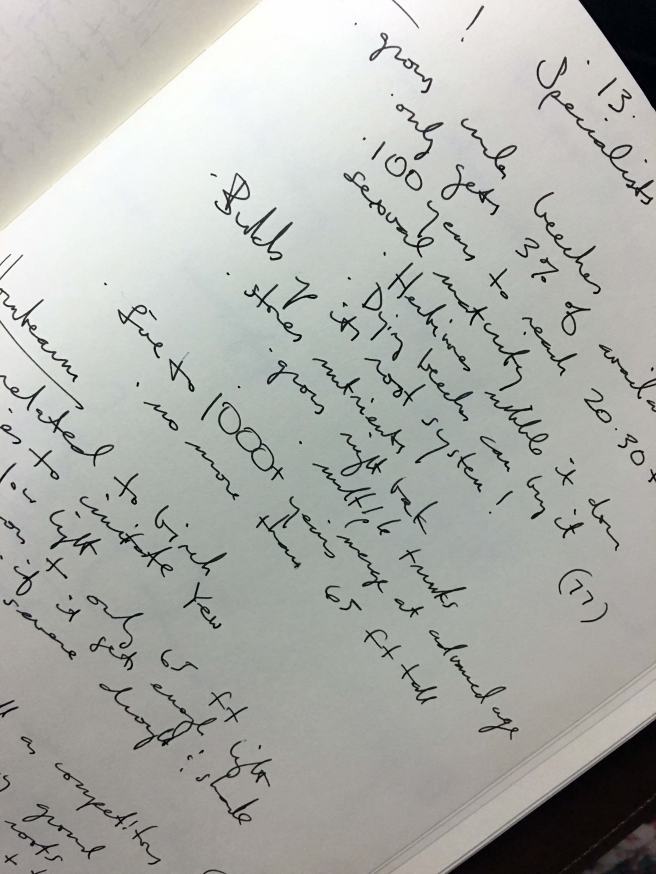
•yew

• grows under beeches

• only gets 3% of available light

• 100 years to reach 20 – 30 feet and sexual maturity

• herbivores nibble them down

• dying beeches can bury it

• builds up its root system (77)

• stores nutrients

• grows right back

• multiple trunks merge at advanced age

• live to 1000+ years

• no more than 65 ft tall

• hornbeam

• related to birch

• tries to imitate yew

• low light

• grows to only 65 ft

• if it gets enough light

• grows in severe drought and shade

• alder

• don’t grow as tall as competitors

• can grow on swampy ground

• air ducts inside roots

• transport oxygen to tiniest tips

• like divers connected to surface via breathing tube

• cork cells in lower trunk

• allow air to enter when underwater

• but after extended period underwater alders can weaken

• fungi eats

reading The Hidden Life of Trees – Chapter 12

hidden-life-of-trees-chapter-12-notes

Peter Wohlleben’s The Hidden Life of Trees

Page numbers in parentheses. Italics are my own questions of the text.

Chapter 11 Notes

Chapter 10 Notes             Chapter 9 Notes      Chapter 8 Notes

Chapter 7 Notes               Chapter 6 Notes      Chapter 5 Notes

Chapters 3 & 4 Notes      Chapter 2 Notes      Foreword, Introductions, and Chapter 1 Notes

Chapter 12 Mighty Oak or Mighty Wimp?

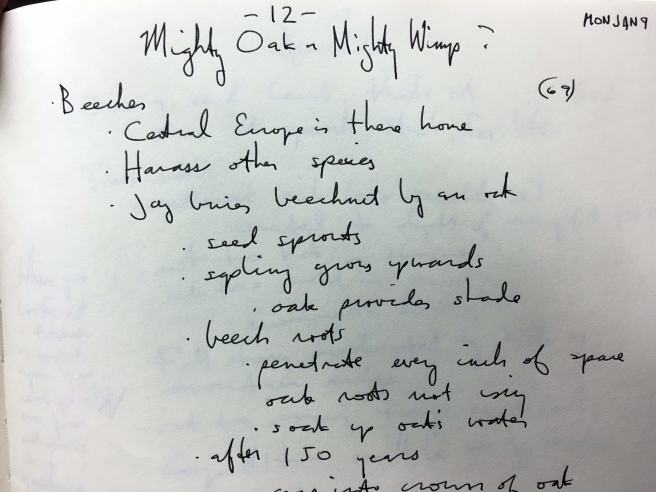
beeches

• central europe is their home (69)

• harass other species

• how?

• jay buries beechnut by an oak

• seed sprouts

• sapling grows upwards

• oak provides shade

• beech roots

• penetrate every inch of space oak roots not using

• soak up oak’s water

• after 150 years

• grows into crown of oak

• extends crown

• catches 97% of light

• oak starves

• desperately tries to grow leaves at base of trunk

• oak

• tough with no competition (70)

• oaks can last 500 years outside the forest

• beeches need the forest – can only last 200 years

• wounds or cracks in trunk:

• protected with tannins (71)

• discourage fungi growth

• branches broken

• can grow replacement crown

• thick bark

• beeches are thin-skinned (72)

reading The Hidden Life of Trees Chapter 11

hidden-life-of-trees-chapter-11-notes

Peter Wohlleben’s The Hidden Life of Trees

Page numbers in parentheses. Italics are my own questions of the text.

Chapter 10 Notes             Chapter 9 Notes      Chapter 8 Notes

Chapter 7 Notes               Chapter 6 Notes      Chapter 5 Notes

Chapters 3 & 4 Notes      Chapter 2 Notes      Foreword, Introductions, and Chapter 1 Notes

Chapter 11 Trees Aging Gracefully

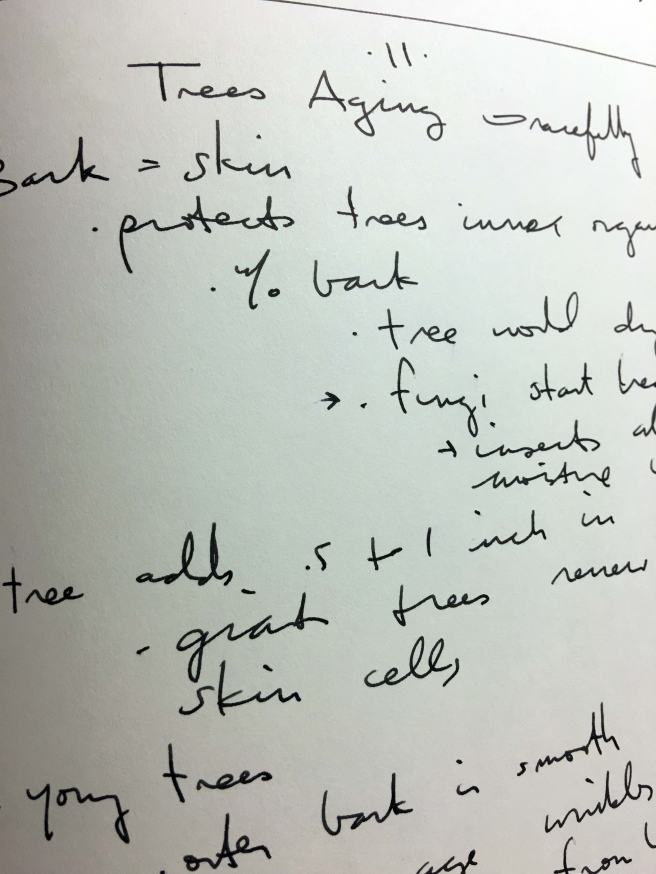
bark = skin

• protects trees inner organs (61)

• without bark

• tree dries out

• fungi start breaking everything down

• insects also invade with lower moisture levels

tree adds .5 to 1 inch in girth

• trees renew skin and shed skin cells

young trees = smooth outer bark (62)

• as trees age wrinkles appear

• starting from bottom

• deepen over time

beeches

• high renewal rate

• skin thin

• matches girth

• doesn’t crack

pines

• shed slowly

• thick oak bark

• exterior layers decades old (63)

• outer layers originated when tree was young

beeches

• once they start to wrinkle

• mosses colonize nooks and crannies

• estimate tree age by height of green moss

• higher the moss, older the tree

canadian west coast (64)

• ancient growth

• sitka spruce

• 500 years old

• moss in branches and forks

• algae

• capture nitrogen

• rain washes nitrogen down trunk

• nitrogen is a fertilizer

• fertilizes young trees

old age

• after 100 – 300 years (65)

• crown growth gets shorter

• every tree gradually stops getting taller

• energy levels drop

• loses twigs top-down

• fungi advance inward (66)

• consume cellulose and lignin

• trees grows outward to counter

• trunk snaps

reading The Hidden Life of Trees -Chapter 10

hidden-life-of-trees-chapter-10-notes

Peter Wohlleben’s The Hidden Life of Trees

Page numbers in parentheses. Italics are my own questions of the text.

Chapter 9 Notes

Chapter 8 Notes

Chapter 7 Notes

Chapter 6 Notes

Chapter 5 Notes

Chapters 3 & 4 Notes

Chapter 2 Notes

Foreword, Introductions, and Chapter 1 Notes

Chapter 10 The Mysteries of Moving Water

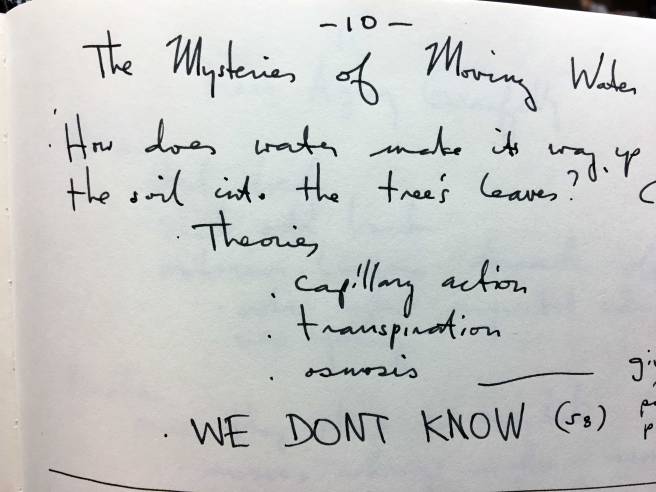
how does water make its way up from the soil into the tree’s leaves? (56)

• WE DON’T KNOW (58)

If we don’t know how trees do this one simple task, drink, then what else don’t we know about trees? We don’t even know what we don’t know, and someone places a ‘value’ on the tree? How can we possibly hope for that value to be accurate? If there’s a value in removal, what’s the value in leaving that tree alone? Has anyone calculated that? And if we can’t put a value on it, does that mean we shouldn’t remove it, or at least think long and hard before we do?

• theories

• capillary action

• can only move the water up about three feet

• transpiration

• doesn’t work all the time

• tree has water even when transpiration can’t be the reason

• osmosis (57)


reading The Hidden Life of Trees – Chapter 9

hidden-life-of-trees-chapter-9-notes

Peter Wohlleben’s The Hidden Life of Trees

Page numbers in parentheses. Italics are my own questions of the text.

Chapter 8 Notes

Chapter 7 Notes

Chapter 6 Notes

Chapter 5 Notes

Chapters 3 & 4 Notes

Chapter 2 Notes

Foreword, Introductions, and Chapter 1 Notes

Chapter 9 United We Stand Divided We Fall

different species fight for light and water

• tap into damp ground (49)

• roots grow fine hairs to increase surface are

• suck up as much water as possible

more is better

• trees pair with fungi

• have for millions of years

plants

• create their own food out of inanimate material

animals

• eat other living things (50)

fungi

• cell walls made of chitin

• chitin

• substance never found in plants

• makes fungi more like insects

• cannot photosynthesize

• depend on organic connections with other living beings they can feed on

• mycelium

• fungi underground web

• expands over decades

• oregon fungi

• 2400 years old

• 2000 acres

• 660 tons

trees can suck up more water with the help of mycelium (50 – 51)

• fungal threads grow into/_between_ soft root hairs

• mycelium web expands (51)

• expanding reach of roots!

• fungi demands up to a third of of tree’s total production

fungi grow to be hundreds of years old (52)

• some species host specific

• chantarelles are not however

• oak • birch • spruce

fungi connect across species lines (53)

• trees may fight other species

• fungi connections give strength to the forest

reading The Hidden Life of Trees – Chapter 8

hidden-life-of-trees-chapter-8-notes

Peter Wohlleben’s The Hidden Life of Trees

page numbers in parentheses. italics are my own questions of the text.

Chapter 7 Notes

Chapter 6 Notes

Chapter 5 Notes

Chapters 3 & 4 Notes

Chapter 2 Notes

Foreword, Introductions, and Chapter 1 Notes

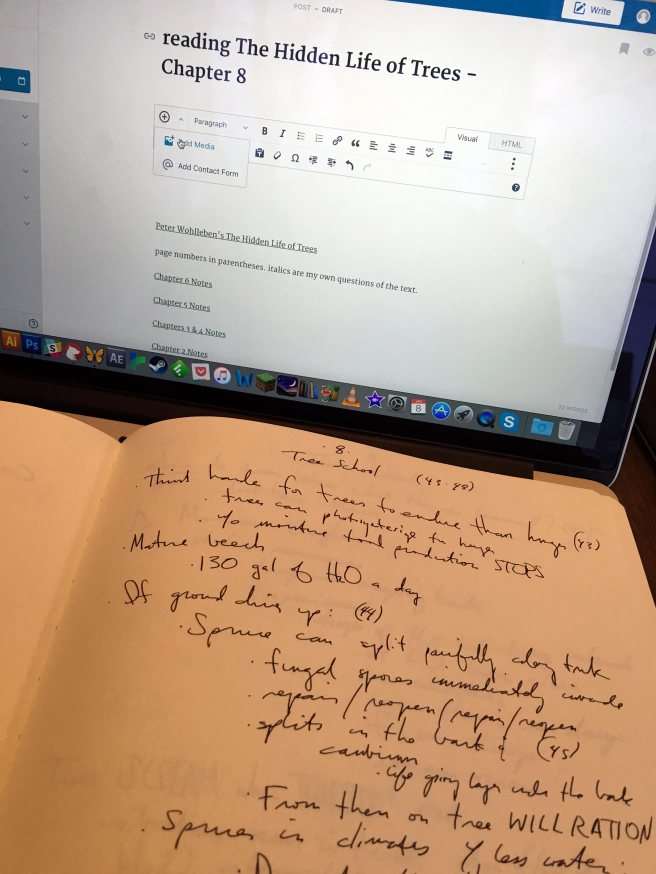
thirst harder for trees to endure than hunger (43)

• trees can photosynthesize when hungry

• without moisture food production STOPS

mature beech

• consumes 130 gal of water a day

if ground dries up

• spruce can split painfully in trunk (44)

• fungal spores immediately invade

• splits in the bark (45)

• repair/reopen/repair/reopen

• cambrium

• life giving layer under the bark

• from then on tree WILL ration

spruces in climates with less water

• do not suffer this way

• slower growth

• ration water

how trees learn to support themselves after loss of neighbor

• micro-tears when bending in the wind (46)

• whatever points hurt that’s where the tree strengthens

• instead of growing

• leaves adapted to low-light

• have to now grow leaves that can handle more light

• takes 2 growing seasons

• conifers take even longer!

• needles stay on branch for up to 10 years

• trees learn, but WHERE do they store what they’ve learned? (47)

• HOW do they store what they’ve learned?

• don’t have brains

• Dr. Monica Gagliano

• studies mimosas

• tropical creeping herb

• experiment:

• drops of water fall on leaves at regular intervals

• first leaves close immediately

• then learn there is no change from drops

• so they remain open!

trees SCREAM when THIRSTY! (48)

• vibrations occur in trunk when flow of water interrupted

• similar to air passing through windpipe in humans (48)

• could be cries of thirst!

reading The Hidden Life of Trees – Chapter 7

hidden-life-of-trees-chapter-7-notes

Peter Wohlleben’s The Hidden Life of Trees

page numbers in parentheses. italics are my own questions of the text.

Chapter 6 Notes

Chapter 5 Notes

Chapters 3 & 4 Notes

Chapter 2 Notes

Foreword, Introductions, and Chapter 1 Notes

Chapter 7 Forest Etiquette

features of a mature well-formed deciduous (37)

• in youth

• narrow branches

• extend away from trunk

• die off

• sealed with new bark

• smooth column

• straight trunk

• regular arrangement of wood fibers

• long and smooth

• roots stretch out evenly in all directions

• reach down into earth under tree

• top

• symmetrical crown

• strong branches

• angling upward

same for conifers except

• topmost branches horizontal (or bent slightly downward)

STABILITY

• windstorm can tear at base of trunk with a force of 220 tons (38)

problematic tree shapes

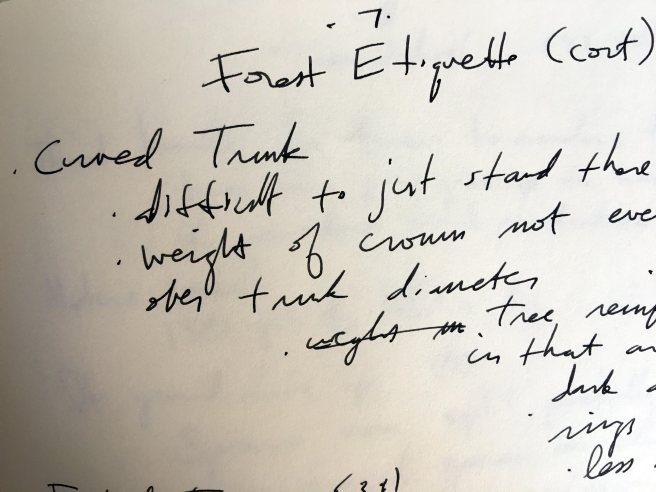
• curved trunk

• difficult to just stand there (38)

• weight of crown not evenly distributed over trunk diameter

• tree reinforces wood in that area

• dark areas in growth rings

• less air and more wood

• forked trees

• each have their own crown

• both swing back and forth in different directions (39)

• U shaped

• tree can make it

• V shaped

• fork breaks at narrowest point

• thick bulges of wood to try and prevent further damage

• bacteria blackened liquid constantly seeps from wood

• water gathers = rot

• banana shaped trunks

• lower part sticks out at an angle (40)

• due to snow or earth slide

trees grow only from the tip (40) what does that mean exactly? tip? tips

conifers grow straight or not at all (41)

• except pines

• crown points towards light

• highest breakage rate due to snow

reading The Hidden Life of Trees – chapter 6

hidden-life-of-trees-chapter-6-notes

Peter Wohlleben’s The Hidden Life of Trees

page numbers in parentheses. italics are my own questions of the text.

Chapter 5 Notes

Chapters 3 & 4 Notes

Chapter 2 Notes

Foreword, Introductions, and Chapter 1 Notes

Chapter 6 Slowly Does It

trees grow slooooooooooow

• beech

• count nodes on branches of young trees (31)

• as the branch gets longer the nodes stay behind

does this method of age determination work with other species as well?

mother trees want slow growth in their children (32)

• slow growth from light deprivation

• slow growth in young trees key to old age

slow growth in natural conditions (33)

• pencil thick trees are 80 – 120 years old

• woody cells are tiny and contain almost no air

• flexible

• resistant to breakage

• resistant to fungi

mothers deliver sugar and nutrients through root systems (34)

if tree is wider than it is tall, it is in waiting mode (34)

• waiting mode

• look like flat-topped bonsai trees (34)

• leaves (or needles) sensitive to low light

• adapted to shade

When the mother tree dies sets off a chain reaction

• falls to ground

• snaps seedlings

• only trees below that grow straight and tall make it

• meandering trees get caught in darkness again

• this darkness even darker

• more photosynthesis

• fruit becomes sweeter (35)

• attracts predatory herbivores

• honeysuckle

• winds its way around saplings

• if canopy closes honeysuckle dies off before killing trees

• neighbors of mother tree close the canopy gap (36)

• once young trees have made it to the middle story

• no longer threatened by competitors