reading The Hidden Life of Trees – chapter 6

hidden-life-of-trees-chapter-6-notes

Peter Wohlleben’s The Hidden Life of Trees

page numbers in parentheses. italics are my own questions of the text.

Chapter 5 Notes

Chapters 3 & 4 Notes

Chapter 2 Notes

Foreword, Introductions, and Chapter 1 Notes

Chapter 6 Slowly Does It

trees grow slooooooooooow

• beech

• count nodes on branches of young trees (31)

• as the branch gets longer the nodes stay behind

does this method of age determination work with other species as well?

mother trees want slow growth in their children (32)

• slow growth from light deprivation

• slow growth in young trees key to old age

slow growth in natural conditions (33)

• pencil thick trees are 80 – 120 years old

• woody cells are tiny and contain almost no air

• flexible

• resistant to breakage

• resistant to fungi

mothers deliver sugar and nutrients through root systems (34)

if tree is wider than it is tall, it is in waiting mode (34)

• waiting mode

• look like flat-topped bonsai trees (34)

• leaves (or needles) sensitive to low light

• adapted to shade

When the mother tree dies sets off a chain reaction

• falls to ground

• snaps seedlings

• only trees below that grow straight and tall make it

• meandering trees get caught in darkness again

• this darkness even darker

• more photosynthesis

• fruit becomes sweeter (35)

• attracts predatory herbivores

• honeysuckle

• winds its way around saplings

• if canopy closes honeysuckle dies off before killing trees

• neighbors of mother tree close the canopy gap (36)

• once young trees have made it to the middle story

• no longer threatened by competitors
reading The Hidden Life of Trees – Chapter 5

hidden-life-of-trees-chapter-5-notes

Peter Wohlleben’s The Hidden Life of Trees.

Chapter 3 & 4 Notes

Chapter 2 Notes

Foreword, Introductions, and Chapter 1 Notes

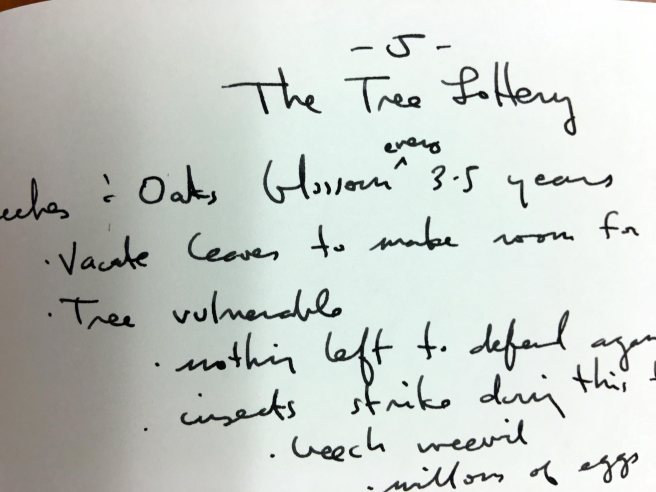
Chapter 5 The Tree Lottery

beeches and oaks blossom every 3 – 5 years

• vacate leaves to make room for blossoms (26)

• trees left vulnerable

• nothing left to defend against sickness or insects

• have to endure insect attack without responding (27)

• sick trees don’t produce fewer blossoms

• protect their genetic legacy

• blossom production has more to do with the previous year than the upcoming year (27)

seeds

• beeches and oaks

• seeds fall directly under mother trees

• sprout as quickly as possible (28)

• bird cherries

• pioneer species

• seeds can lie dormant for up to 5 years

only one tree will reach adulthood! (29)

• beeches = 30k beechnuts

• sexually mature @ 80 – 150 years

• live about 400 years

• 60 fruitings over that span

= 1.8 million beechnuts

• poplars

• 54 million seeds every year

• more than a billion seeds in a lifetime (30)

reading The Hidden Life of Trees – Chapters 3 and 4

These are my chapters 3 and 4 notes from Peter Wohlleben’s The Hidden Life of Trees.

Notes Entry 1 – A foreword, two introductions, and chapter 1

Notes Entry 2 – chapter 2

I just realized how boring these last three photos from my notes are. Just photos of a book, my notebook, my pen, and maybe my hand.

If you’d like more exciting images, you could always take a look at my (short) videos.

Onward!

hidden-life-of-trees-chapter-3-notes.JPG

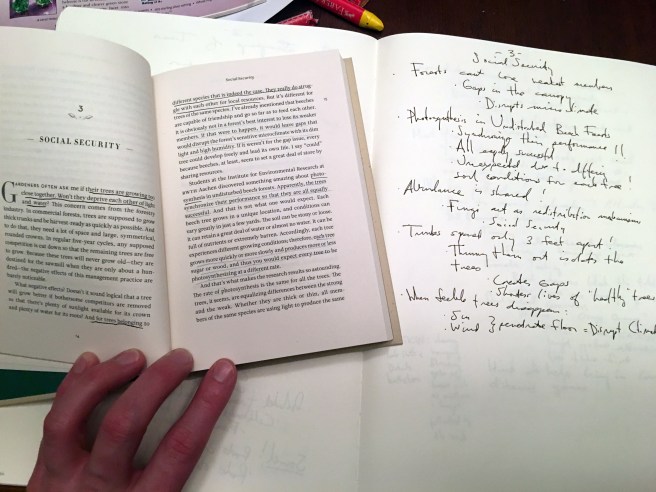
Chapter 3 – Social Security

forests don’t want to lose weakest members (15)

• creates gaps in canopy (15)

• disrupts local climate (15)

photosynthesis in undisturbed beech forests: (15)

• synchronized between trees! (15)

• all equally successful (15)

• UNEXPECTED due to different soil conditions for each tree (15)

abundance is SHARED (16)

• fungi act as redistribution mechanisms (16)

•’social security’ (16)

• thinning trees out ISOLATES them (17)

• creates gaps in communication (17)

• shortens lives of the healthy trees (17)

when feeble trees disappear: (17)

• sun and wind penetrate to forest floor (17)

!disrupts climate! (17)

Chapter 4 – Love

reproduction planned 1 year in advance in deciduous trees (19)

• 3 – 5 years

• deciduous trees decide based on conditions (19)

• so that herbivores can’t count on beech nuts and acorns (19 – 20)

• conifers send out seeds yearly (19)

‘mast year’ (20)

• year when beeches and oaks set seed

• multi year gaps cause herbivores numbers to crash

• helps seedlings sprout

trees that use WIND for pollination (21)

• how to avoid inbreeding (pollinating its own flowers)? (22)

• timing (22)

• male and female blossoms flower a few days apart

• genetic testing! (22 – 23)

• bird cherries block the tube unless there are foreign genes present

• individual genders (23)

• willows osage orange trees?

• males make catkins BRIGHT YELLOW to attract bees there first (24)

• wind also brings in long distance genes (24)

funnel weaver

If I spy them before the mower gets them, I try to mow around the web funnels in the yard.

When out of their web funnels, I’ve seen these spiders move quickly through the grass.

This site has been great at helping to identify a few of the different spiders in the yard.

The video above has been slowed down 300%.

Please feel free to add further identification help in the comments below.