reading The Hidden Life of Trees Chapter 11

hidden-life-of-trees-chapter-11-notes

Peter Wohlleben’s The Hidden Life of Trees

Page numbers in parentheses. Italics are my own questions of the text.

Chapter 10 Notes             Chapter 9 Notes      Chapter 8 Notes

Chapter 7 Notes               Chapter 6 Notes      Chapter 5 Notes

Chapters 3 & 4 Notes      Chapter 2 Notes      Foreword, Introductions, and Chapter 1 Notes

Chapter 11 Trees Aging Gracefully

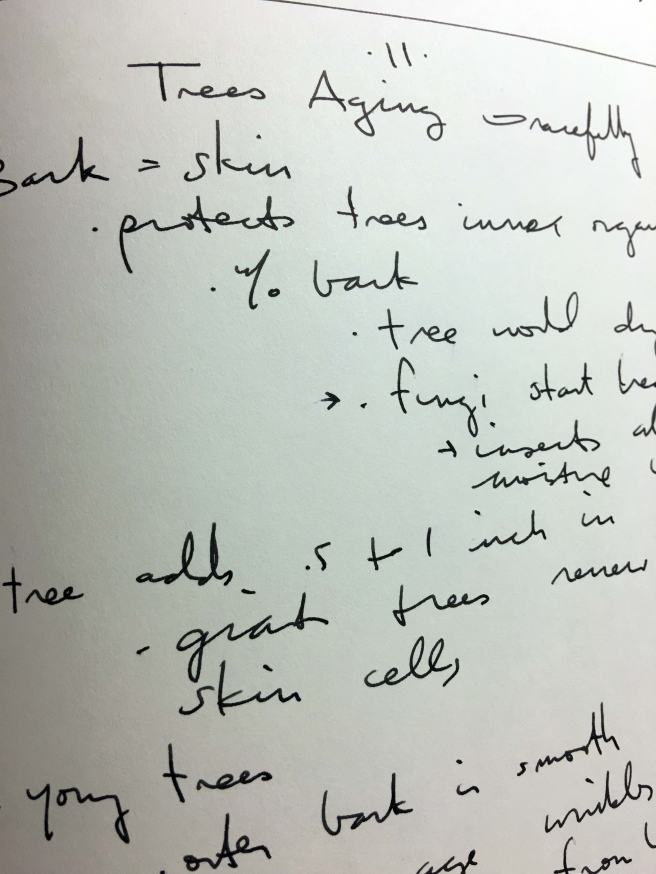
bark = skin

• protects trees inner organs (61)

• without bark

• tree dries out

• fungi start breaking everything down

• insects also invade with lower moisture levels

tree adds .5 to 1 inch in girth

• trees renew skin and shed skin cells

young trees = smooth outer bark (62)

• as trees age wrinkles appear

• starting from bottom

• deepen over time

beeches

• high renewal rate

• skin thin

• matches girth

• doesn’t crack

pines

• shed slowly

• thick oak bark

• exterior layers decades old (63)

• outer layers originated when tree was young

beeches

• once they start to wrinkle

• mosses colonize nooks and crannies

• estimate tree age by height of green moss

• higher the moss, older the tree

canadian west coast (64)

• ancient growth

• sitka spruce

• 500 years old

• moss in branches and forks

• algae

• capture nitrogen

• rain washes nitrogen down trunk

• nitrogen is a fertilizer

• fertilizes young trees

old age

• after 100 – 300 years (65)

• crown growth gets shorter

• every tree gradually stops getting taller

• energy levels drop

• loses twigs top-down

• fungi advance inward (66)

• consume cellulose and lignin

• trees grows outward to counter

• trunk snaps
reading The Hidden Life of Trees -Chapter 10

hidden-life-of-trees-chapter-10-notes

Peter Wohlleben’s The Hidden Life of Trees

Page numbers in parentheses. Italics are my own questions of the text.

Chapter 9 Notes

Chapter 8 Notes

Chapter 7 Notes

Chapter 6 Notes

Chapter 5 Notes

Chapters 3 & 4 Notes

Chapter 2 Notes

Foreword, Introductions, and Chapter 1 Notes

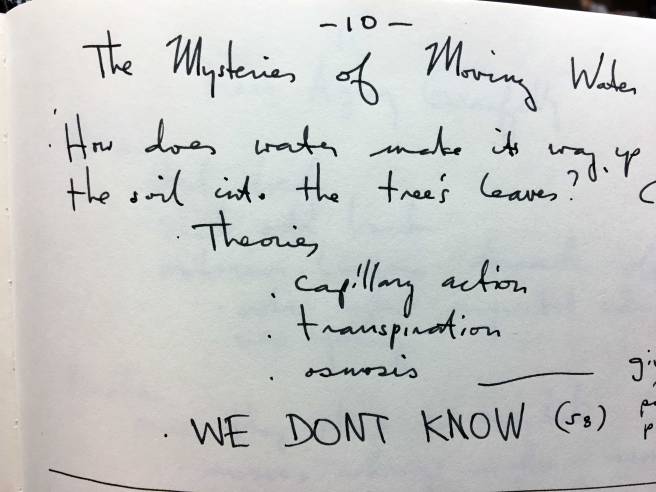
Chapter 10 The Mysteries of Moving Water

how does water make its way up from the soil into the tree’s leaves? (56)

• WE DON’T KNOW (58)

If we don’t know how trees do this one simple task, drink, then what else don’t we know about trees? We don’t even know what we don’t know, and someone places a ‘value’ on the tree? How can we possibly hope for that value to be accurate? If there’s a value in removal, what’s the value in leaving that tree alone? Has anyone calculated that? And if we can’t put a value on it, does that mean we shouldn’t remove it, or at least think long and hard before we do?

• theories

• capillary action

• can only move the water up about three feet

• transpiration

• doesn’t work all the time

• tree has water even when transpiration can’t be the reason

• osmosis (57)


reading The Hidden Life of Trees – Chapter 9

hidden-life-of-trees-chapter-9-notes

Peter Wohlleben’s The Hidden Life of Trees

Page numbers in parentheses. Italics are my own questions of the text.

Chapter 8 Notes

Chapter 7 Notes

Chapter 6 Notes

Chapter 5 Notes

Chapters 3 & 4 Notes

Chapter 2 Notes

Foreword, Introductions, and Chapter 1 Notes

Chapter 9 United We Stand Divided We Fall

different species fight for light and water

• tap into damp ground (49)

• roots grow fine hairs to increase surface are

• suck up as much water as possible

more is better

• trees pair with fungi

• have for millions of years

plants

• create their own food out of inanimate material

animals

• eat other living things (50)

fungi

• cell walls made of chitin

• chitin

• substance never found in plants

• makes fungi more like insects

• cannot photosynthesize

• depend on organic connections with other living beings they can feed on

• mycelium

• fungi underground web

• expands over decades

• oregon fungi

• 2400 years old

• 2000 acres

• 660 tons

trees can suck up more water with the help of mycelium (50 – 51)

• fungal threads grow into/_between_ soft root hairs

• mycelium web expands (51)

• expanding reach of roots!

• fungi demands up to a third of of tree’s total production

fungi grow to be hundreds of years old (52)

• some species host specific

• chantarelles are not however

• oak • birch • spruce

fungi connect across species lines (53)

• trees may fight other species

• fungi connections give strength to the forest

reading The Hidden Life of Trees – Chapter 8

hidden-life-of-trees-chapter-8-notes

Peter Wohlleben’s The Hidden Life of Trees

page numbers in parentheses. italics are my own questions of the text.

Chapter 7 Notes

Chapter 6 Notes

Chapter 5 Notes

Chapters 3 & 4 Notes

Chapter 2 Notes

Foreword, Introductions, and Chapter 1 Notes

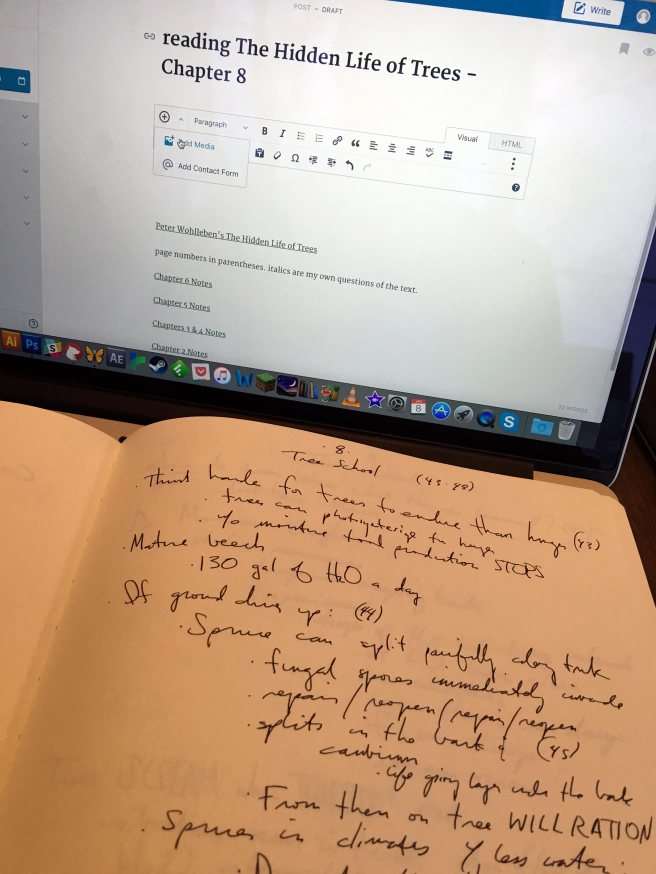
thirst harder for trees to endure than hunger (43)

• trees can photosynthesize when hungry

• without moisture food production STOPS

mature beech

• consumes 130 gal of water a day

if ground dries up

• spruce can split painfully in trunk (44)

• fungal spores immediately invade

• splits in the bark (45)

• repair/reopen/repair/reopen

• cambrium

• life giving layer under the bark

• from then on tree WILL ration

spruces in climates with less water

• do not suffer this way

• slower growth

• ration water

how trees learn to support themselves after loss of neighbor

• micro-tears when bending in the wind (46)

• whatever points hurt that’s where the tree strengthens

• instead of growing

• leaves adapted to low-light

• have to now grow leaves that can handle more light

• takes 2 growing seasons

• conifers take even longer!

• needles stay on branch for up to 10 years

• trees learn, but WHERE do they store what they’ve learned? (47)

• HOW do they store what they’ve learned?

• don’t have brains

• Dr. Monica Gagliano

• studies mimosas

• tropical creeping herb

• experiment:

• drops of water fall on leaves at regular intervals

• first leaves close immediately

• then learn there is no change from drops

• so they remain open!

trees SCREAM when THIRSTY! (48)

• vibrations occur in trunk when flow of water interrupted

• similar to air passing through windpipe in humans (48)

• could be cries of thirst!

reading The Hidden Life of Trees – Chapter 7

hidden-life-of-trees-chapter-7-notes

Peter Wohlleben’s The Hidden Life of Trees

page numbers in parentheses. italics are my own questions of the text.

Chapter 6 Notes

Chapter 5 Notes

Chapters 3 & 4 Notes

Chapter 2 Notes

Foreword, Introductions, and Chapter 1 Notes

Chapter 7 Forest Etiquette

features of a mature well-formed deciduous (37)

• in youth

• narrow branches

• extend away from trunk

• die off

• sealed with new bark

• smooth column

• straight trunk

• regular arrangement of wood fibers

• long and smooth

• roots stretch out evenly in all directions

• reach down into earth under tree

• top

• symmetrical crown

• strong branches

• angling upward

same for conifers except

• topmost branches horizontal (or bent slightly downward)

STABILITY

• windstorm can tear at base of trunk with a force of 220 tons (38)

problematic tree shapes

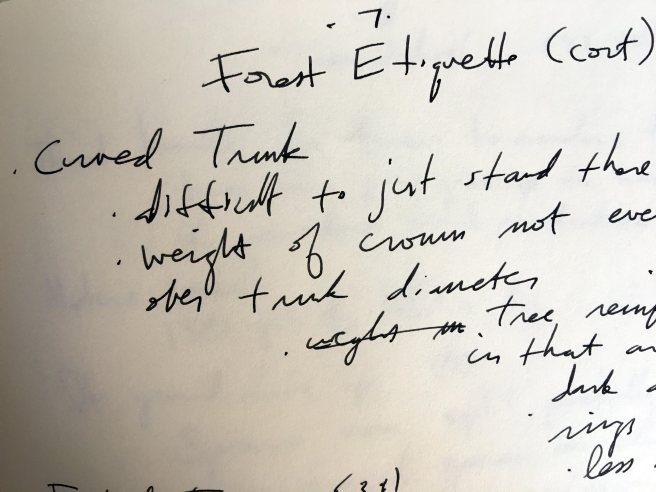
• curved trunk

• difficult to just stand there (38)

• weight of crown not evenly distributed over trunk diameter

• tree reinforces wood in that area

• dark areas in growth rings

• less air and more wood

• forked trees

• each have their own crown

• both swing back and forth in different directions (39)

• U shaped

• tree can make it

• V shaped

• fork breaks at narrowest point

• thick bulges of wood to try and prevent further damage

• bacteria blackened liquid constantly seeps from wood

• water gathers = rot

• banana shaped trunks

• lower part sticks out at an angle (40)

• due to snow or earth slide

trees grow only from the tip (40) what does that mean exactly? tip? tips

conifers grow straight or not at all (41)

• except pines

• crown points towards light

• highest breakage rate due to snow