reading The Hidden Life of Trees – Chapter 21

hidden-life-of-trees-chapter-21-notes

Peter Wohlleben’s The Hidden Life of Trees

Page numbers in parentheses. Italics are my own questions of the text.

Chapter 20 Notes

Chapter 17 Notes            Chapter 18 Notes          Chapter 19 Notes

Chapter 14 Notes             Chapter 15 Notes         Chapter 16 Notes

Chapter 13 Notes             Chapter 12 Notes         Chapter 11 Notes

Chapter 10 Notes             Chapter 9 Notes           Chapter 8 Notes

Chapter 7 Notes               Chapter 6 Notes           Chapter 5 Notes

Chapters 3 & 4 Notes      Chapter 2 Notes      Foreword, Introductions, and Chapter 1 Notes

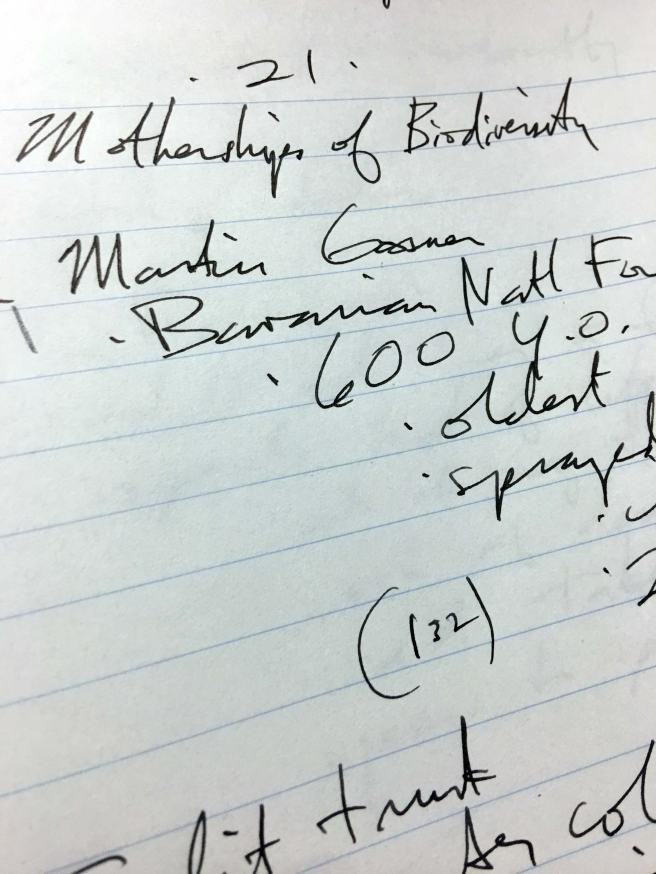
Chapter 21 – Mothership of Biodiversity

dr martin gossner (131)

• bavarian national forest

• 600 year old tree

• oldest in the forest

• sprayed with insecticide pyrethum

• 2,041 animals (132)

• 257 different species

split trunk of tree

• rainwater collects at point of division

• home to tiny flies that are food for beetles

trunk cavities with water

• even though its dark with low oxygen species live there too

• bumblebee hover fly larvae

• have snorkels

• bacteria as food source

dead trunk (133)

• resource for children trees

• little trees don’t have direct access to the dead trunk

• need help from other organisms

• fungi and insects

stag beetles (133)

• adult only lives a few weeks

• can stay in larvae stage for 8 years

• eats its way through dead roots of deciduous trees

6,000 species depend on dead wood

• removing dead wood destroys habitat

• live wood is of no use to species that live in dead wood

spruce

• sprout particularly well in cradle of dead parent tree

• nurse log reproduction or cadaver rejuvenation

reading The Hidden Life of Trees – Chapter 19 – Yours and Mine

hidden-life-of-trees-chapter-19-notes

Peter Wohlleben’s The Hidden Life of Trees

Page numbers in parentheses. Italics are my own questions of the text.

Chapter 17 Notes            Chapter 18 Notes

Chapter 14 Notes             Chapter 15 Notes         Chapter 16 Notes

Chapter 13 Notes             Chapter 12 Notes         Chapter 11 Notes

Chapter 10 Notes             Chapter 9 Notes           Chapter 8 Notes

Chapter 7 Notes               Chapter 6 Notes           Chapter 5 Notes

Chapters 3 & 4 Notes      Chapter 2 Notes      Foreword, Introductions, and Chapter 1 Notes

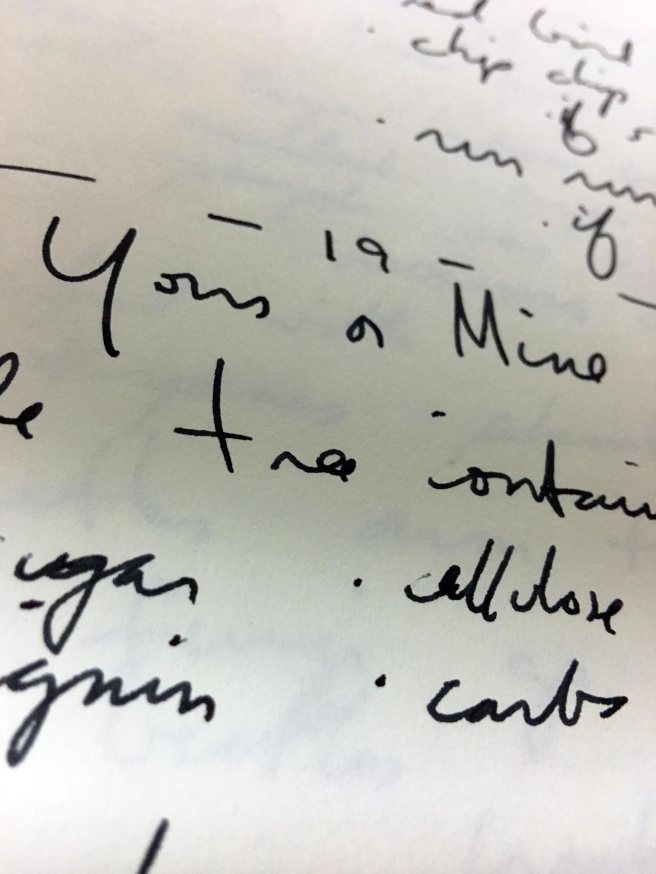
Chapter 19 – Yours and Mine

this chapter outlines all of the ways trees get attacked throughout their lifetime

single tree contains millions of calories (114)

• sugar • cellulose • lignin • carbs

• woodpecker

• beak and head muscles absorb impact

• sapsuckers drill dotted line in the thinner branches

• trees must tolerate

• aphids

• attach mouth sucking parts to veins in leaves and needles

• sap runs right through them out into very large droplets – ‘honeydew’

• very little protein

• expel mostly carbs and sugar

• specialized aphids for each tree species

• wooly beetle scale (115)

• attacks bark

• envelop trunks with silvery white wool

• festering wounds in bark

• take a long time to heal

• if fungi get in tree can die

• ladybug larvae (116)

• devour aphids

• forest ants

• eat honeydew right off aphid backsides

• ants protect the aphids

• honeybees

• make dark forest honey out of honeydew

• gall midges and wasps

• larvae feed on leaves

• saliva reprograms leaves to grow into casing, also called a gall

• leaves fall to the ground, and the midge pupates and hatches (117)

• caterpillars

• eat leaves and needles in their entirety

• trees stripped of leaves by june

• tree mounts a comeback

• however after 2 – 3 years in a row of attacks, trees can die

• bird cherry (118)

• leaves contain nectar gland

• nectar for ants

• ants rid the bird cherry of caterpillars

• ants will farm aphids (119)

• barb beetle

• single beetle mounts attack

• if successful calls in reinforcements

• or tree kills first beetle

• cambrium

• active layer between bark and wood

• succulent • sugar • minerals

• people can eat

• tastes like resinous carrot

• spruce

• defend with

• terpenes, phenols

• can kill beetles

• beetles arm themselves with fungi

• fungi go in ahead of the beetles

• fungi moves faster than drilling beetles

• fungi breaks down defense chemicals into harmless substances

• large herbivores (120)

• not much greenery on forest floor

• leaves of trees in crown too high

• not many deer in forests

• old tree falls over

• light reaches forest floor for a few years

• wild flowers and grasses grow

• light = sugar

• trees bud (121)

• trees have to grow fast enough that the large herbivores can’t get to them

• honey fungus mushroom

• fruiting body on tree stumps in fall (122)

• mycelium

• force their way into roots

• steal from cambrium

• eat through wood

• causes host wood to rot

• pinesap

• same family as blueberries

• can’t photosynthesize

• taps into link between fungi & roots

• small cow wheat

• similar to pinesap

• male deer

• rub the velvet off antlers using young trees

• uses the uncommon local tree for some reason why?

• trees equal less than 4 inches

• grass is a rarity in a natural forest

• deer forced into forests

• sneak out at night

• eat tree bark in desperation

• tree is full in summer

• bark easy to peel

• winter

• deer can only peel off chunks

• trees in natural woods can survive this

• tough because of slow growth

• commercial forests

• trees grow quickly

• contain a great deal of air

• room for fungi

• snap in middle age

reading The Hidden Life of Trees – Chapter 14 – Tree or Not Tree?

hidden-life-of-trees-chapter-14-notes

Peter Wohlleben’s The Hidden Life of Trees

Page numbers in parentheses. Italics are my own questions of the text.

Chapter 11 Notes              Chapter 12 Notes    Chapter 13 Notes

Chapter 10 Notes             Chapter 9 Notes      Chapter 8 Notes

Chapter 7 Notes               Chapter 6 Notes      Chapter 5 Notes

Chapters 3 & 4 Notes      Chapter 2 Notes      Foreword, Introductions, and Chapter 1 Notes

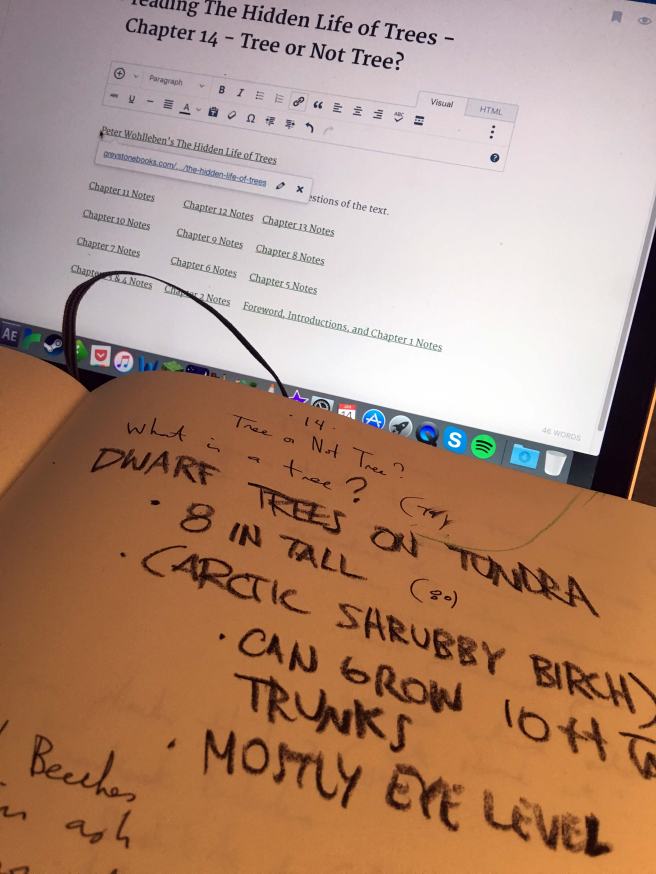
Chapter 14 – Tree or Not Tree?

what is a tree? (79)

• dwarf trees on tundra

• 8 inches tall (80)

• (arctic shrubby birch)

• can grow 10 ft tall trunks

• mostly eye level

small beeches, mountain ash

• browsed on by mammals

• grow multiple shoots like bushes

stump?

• new stumps grow out of old stumps

• ‘coppicing’

• trees cut down to base of stump

• new trunks grow from base

• oak and hornbeam

• are those trunks now young trees? (81)

• or are they thousands of years old?

• oldest spruce in Dalarna

• flat shrubby growth around small single trunk

• carbon 14 dating = 9,550 years old!

root regrows trunk time and time again

• roots most important part of tree (82)

• equivalent of brain

• has to store experience somewhere

• most permanent part of tree

• where else would it store information?

can plants think? (83)

• frantisek baluska

• institute of cellular and molecular biology university of bonn

• brain like structure in root tips

• root feels its way through the ground

• aware of stimuli

• toxins

• stones

• saturated soil

reading The Hidden Life of Trees – Chapter 13 – Specialists

hidden-life-of-trees-chapter-13-notes

Peter Wohlleben’s The Hidden Life of Trees

Page numbers in parentheses. Italics are my own questions of the text.

Chapter 11 Notes              Chapter 12 Notes

Chapter 10 Notes             Chapter 9 Notes      Chapter 8 Notes

Chapter 7 Notes               Chapter 6 Notes      Chapter 5 Notes

Chapters 3 & 4 Notes      Chapter 2 Notes      Foreword, Introductions, and Chapter 1 Notes

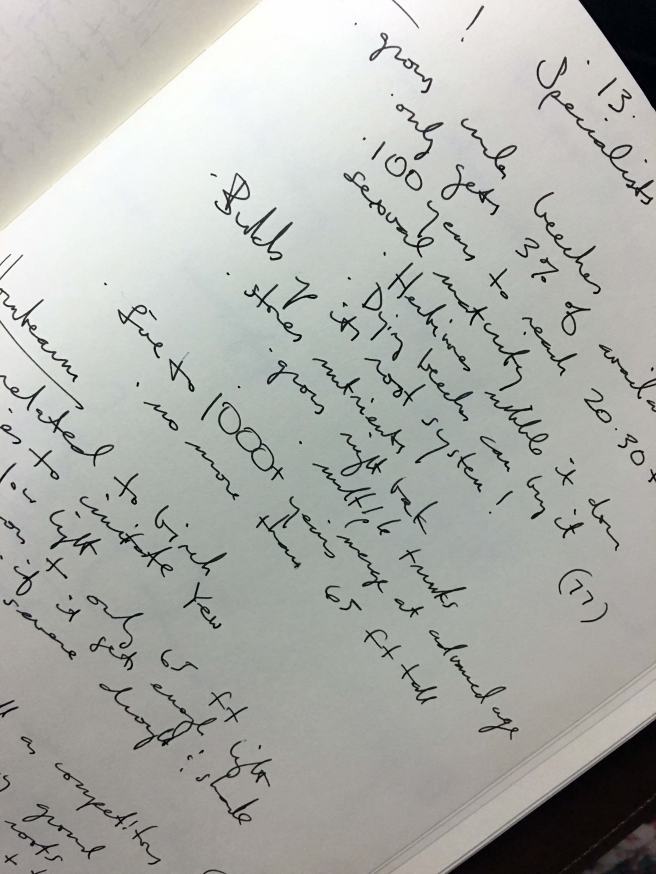
Chapter 13 – Specialists

once a seed lands, there’s not many transportation opportunities (73)

• once it sprouts, it’s stuck in that spot for life

• trees want:

• nutrient rich loose crumbly soil

• aerated to a depth of many feet (74)

• not too hot in summer

• not too cold in winter

• moderate snowfall

• fall storms moderated by hills or mountain ridges

• not too many fungi in forest

• if all this occurred competition would be won by beeches

when you look at a forest or woods after reading this book you realize every tree out there is a goddamn miracle

• spruce (75)

• can get foothold where summer is short and winter cold

• store oils in needles and bark

• antifreeze

• even with just a few weeks of photosynthesis can grow an inch or two in a year

• holding needles is risky

• snowfall can break a tree

• so it grows a STRAIGHT trunk

• branch angles down as snow falls on them (76)

• most snow falls around not on

• needles present more surface area to wind

• protected by slow rate of growth

•yew

• grows under beeches

• only gets 3% of available light

• 100 years to reach 20 – 30 feet and sexual maturity

• herbivores nibble them down

• dying beeches can bury it

• builds up its root system (77)

• stores nutrients

• grows right back

• multiple trunks merge at advanced age

• live to 1000+ years

• no more than 65 ft tall

• hornbeam

• related to birch

• tries to imitate yew

• low light

• grows to only 65 ft

• if it gets enough light

• grows in severe drought and shade

• alder

• don’t grow as tall as competitors

• can grow on swampy ground

• air ducts inside roots

• transport oxygen to tiniest tips

• like divers connected to surface via breathing tube

• cork cells in lower trunk

• allow air to enter when underwater

• but after extended period underwater alders can weaken

• fungi eats

reading The Hidden Life of Trees – Chapter 12

hidden-life-of-trees-chapter-12-notes

Peter Wohlleben’s The Hidden Life of Trees

Page numbers in parentheses. Italics are my own questions of the text.

Chapter 11 Notes

Chapter 10 Notes             Chapter 9 Notes      Chapter 8 Notes

Chapter 7 Notes               Chapter 6 Notes      Chapter 5 Notes

Chapters 3 & 4 Notes      Chapter 2 Notes      Foreword, Introductions, and Chapter 1 Notes

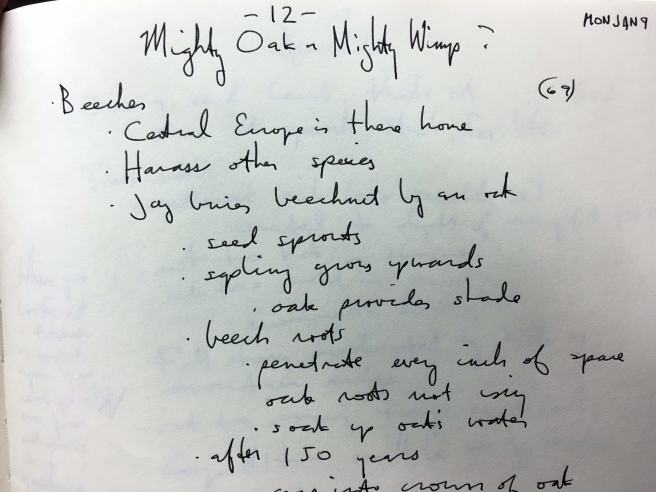
Chapter 12 Mighty Oak or Mighty Wimp?

beeches

• central europe is their home (69)

• harass other species

• how?

• jay buries beechnut by an oak

• seed sprouts

• sapling grows upwards

• oak provides shade

• beech roots

• penetrate every inch of space oak roots not using

• soak up oak’s water

• after 150 years

• grows into crown of oak

• extends crown

• catches 97% of light

• oak starves

• desperately tries to grow leaves at base of trunk

• oak

• tough with no competition (70)

• oaks can last 500 years outside the forest

• beeches need the forest – can only last 200 years

• wounds or cracks in trunk:

• protected with tannins (71)

• discourage fungi growth

• branches broken

• can grow replacement crown

• thick bark

• beeches are thin-skinned (72)

reading The Hidden Life of Trees -Chapter 10

hidden-life-of-trees-chapter-10-notes

Peter Wohlleben’s The Hidden Life of Trees

Page numbers in parentheses. Italics are my own questions of the text.

Chapter 9 Notes

Chapter 8 Notes

Chapter 7 Notes

Chapter 6 Notes

Chapter 5 Notes

Chapters 3 & 4 Notes

Chapter 2 Notes

Foreword, Introductions, and Chapter 1 Notes

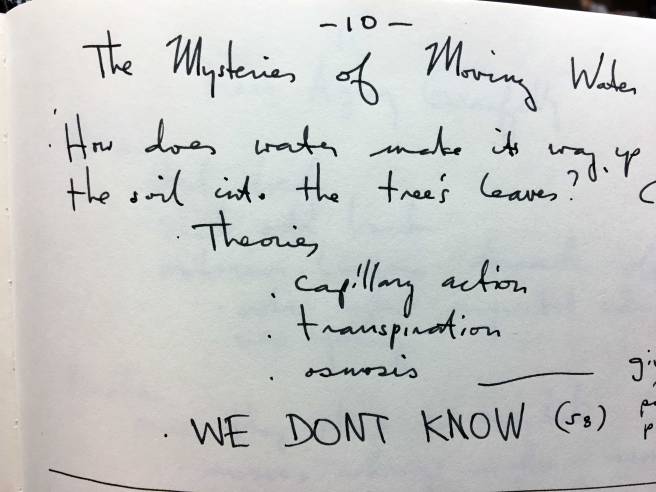
Chapter 10 The Mysteries of Moving Water

how does water make its way up from the soil into the tree’s leaves? (56)

• WE DON’T KNOW (58)

If we don’t know how trees do this one simple task, drink, then what else don’t we know about trees? We don’t even know what we don’t know, and someone places a ‘value’ on the tree? How can we possibly hope for that value to be accurate? If there’s a value in removal, what’s the value in leaving that tree alone? Has anyone calculated that? And if we can’t put a value on it, does that mean we shouldn’t remove it, or at least think long and hard before we do?

• theories

• capillary action

• can only move the water up about three feet

• transpiration

• doesn’t work all the time

• tree has water even when transpiration can’t be the reason

• osmosis (57)


reading The Hidden Life of Trees – Chapter 9

hidden-life-of-trees-chapter-9-notes

Peter Wohlleben’s The Hidden Life of Trees

Page numbers in parentheses. Italics are my own questions of the text.

Chapter 8 Notes

Chapter 7 Notes

Chapter 6 Notes

Chapter 5 Notes

Chapters 3 & 4 Notes

Chapter 2 Notes

Foreword, Introductions, and Chapter 1 Notes

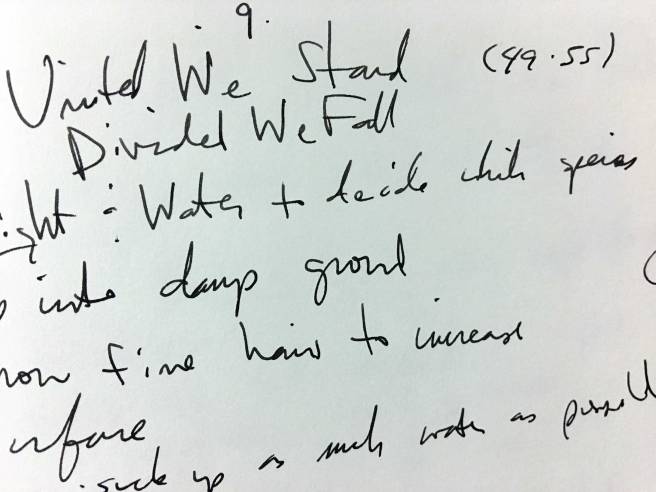
Chapter 9 United We Stand Divided We Fall

different species fight for light and water

• tap into damp ground (49)

• roots grow fine hairs to increase surface are

• suck up as much water as possible

more is better

• trees pair with fungi

• have for millions of years

plants

• create their own food out of inanimate material

animals

• eat other living things (50)

fungi

• cell walls made of chitin

• chitin

• substance never found in plants

• makes fungi more like insects

• cannot photosynthesize

• depend on organic connections with other living beings they can feed on

• mycelium

• fungi underground web

• expands over decades

• oregon fungi

• 2400 years old

• 2000 acres

• 660 tons

trees can suck up more water with the help of mycelium (50 – 51)

• fungal threads grow into/_between_ soft root hairs

• mycelium web expands (51)

• expanding reach of roots!

• fungi demands up to a third of of tree’s total production

fungi grow to be hundreds of years old (52)

• some species host specific

• chantarelles are not however

• oak • birch • spruce

fungi connect across species lines (53)

• trees may fight other species

• fungi connections give strength to the forest

reading The Hidden Life of Trees – Chapter 7

hidden-life-of-trees-chapter-7-notes

Peter Wohlleben’s The Hidden Life of Trees

page numbers in parentheses. italics are my own questions of the text.

Chapter 6 Notes

Chapter 5 Notes

Chapters 3 & 4 Notes

Chapter 2 Notes

Foreword, Introductions, and Chapter 1 Notes

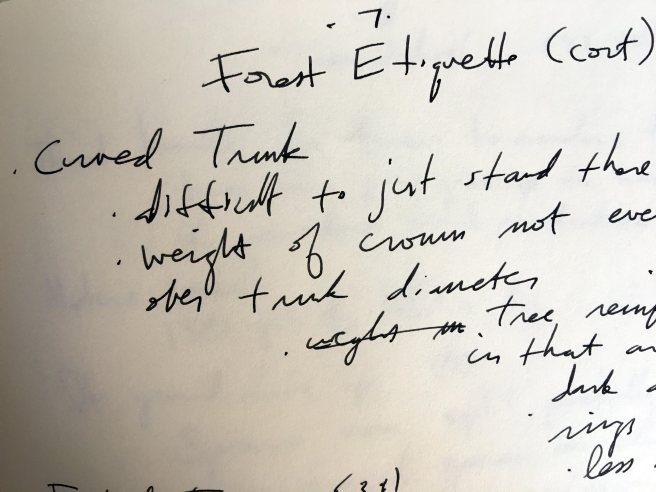
Chapter 7 Forest Etiquette

features of a mature well-formed deciduous (37)

• in youth

• narrow branches

• extend away from trunk

• die off

• sealed with new bark

• smooth column

• straight trunk

• regular arrangement of wood fibers

• long and smooth

• roots stretch out evenly in all directions

• reach down into earth under tree

• top

• symmetrical crown

• strong branches

• angling upward

same for conifers except

• topmost branches horizontal (or bent slightly downward)

STABILITY

• windstorm can tear at base of trunk with a force of 220 tons (38)

problematic tree shapes

• curved trunk

• difficult to just stand there (38)

• weight of crown not evenly distributed over trunk diameter

• tree reinforces wood in that area

• dark areas in growth rings

• less air and more wood

• forked trees

• each have their own crown

• both swing back and forth in different directions (39)

• U shaped

• tree can make it

• V shaped

• fork breaks at narrowest point

• thick bulges of wood to try and prevent further damage

• bacteria blackened liquid constantly seeps from wood

• water gathers = rot

• banana shaped trunks

• lower part sticks out at an angle (40)

• due to snow or earth slide

trees grow only from the tip (40) what does that mean exactly? tip? tips

conifers grow straight or not at all (41)

• except pines

• crown points towards light

• highest breakage rate due to snow

reading The Hidden Life of Trees – chapter 6

hidden-life-of-trees-chapter-6-notes

Peter Wohlleben’s The Hidden Life of Trees

page numbers in parentheses. italics are my own questions of the text.

Chapter 5 Notes

Chapters 3 & 4 Notes

Chapter 2 Notes

Foreword, Introductions, and Chapter 1 Notes

Chapter 6 Slowly Does It

trees grow slooooooooooow

• beech

• count nodes on branches of young trees (31)

• as the branch gets longer the nodes stay behind

does this method of age determination work with other species as well?

mother trees want slow growth in their children (32)

• slow growth from light deprivation

• slow growth in young trees key to old age

slow growth in natural conditions (33)

• pencil thick trees are 80 – 120 years old

• woody cells are tiny and contain almost no air

• flexible

• resistant to breakage

• resistant to fungi

mothers deliver sugar and nutrients through root systems (34)

if tree is wider than it is tall, it is in waiting mode (34)

• waiting mode

• look like flat-topped bonsai trees (34)

• leaves (or needles) sensitive to low light

• adapted to shade

When the mother tree dies sets off a chain reaction

• falls to ground

• snaps seedlings

• only trees below that grow straight and tall make it

• meandering trees get caught in darkness again

• this darkness even darker

• more photosynthesis

• fruit becomes sweeter (35)

• attracts predatory herbivores

• honeysuckle

• winds its way around saplings

• if canopy closes honeysuckle dies off before killing trees

• neighbors of mother tree close the canopy gap (36)

• once young trees have made it to the middle story

• no longer threatened by competitors

reading The Hidden Life of Trees – Chapters 3 and 4

These are my chapters 3 and 4 notes from Peter Wohlleben’s The Hidden Life of Trees.

Notes Entry 1 – A foreword, two introductions, and chapter 1

Notes Entry 2 – chapter 2

I just realized how boring these last three photos from my notes are. Just photos of a book, my notebook, my pen, and maybe my hand.

If you’d like more exciting images, you could always take a look at my (short) videos.

Onward!

hidden-life-of-trees-chapter-3-notes.JPG

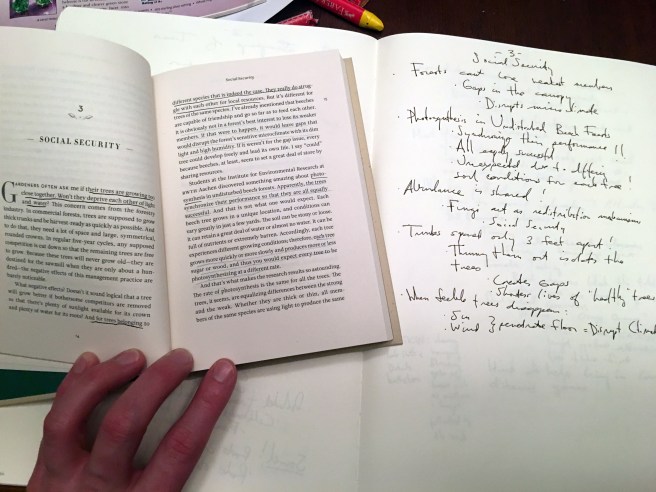
Chapter 3 – Social Security

forests don’t want to lose weakest members (15)

• creates gaps in canopy (15)

• disrupts local climate (15)

photosynthesis in undisturbed beech forests: (15)

• synchronized between trees! (15)

• all equally successful (15)

• UNEXPECTED due to different soil conditions for each tree (15)

abundance is SHARED (16)

• fungi act as redistribution mechanisms (16)

•’social security’ (16)

• thinning trees out ISOLATES them (17)

• creates gaps in communication (17)

• shortens lives of the healthy trees (17)

when feeble trees disappear: (17)

• sun and wind penetrate to forest floor (17)

!disrupts climate! (17)

Chapter 4 – Love

reproduction planned 1 year in advance in deciduous trees (19)

• 3 – 5 years

• deciduous trees decide based on conditions (19)

• so that herbivores can’t count on beech nuts and acorns (19 – 20)

• conifers send out seeds yearly (19)

‘mast year’ (20)

• year when beeches and oaks set seed

• multi year gaps cause herbivores numbers to crash

• helps seedlings sprout

trees that use WIND for pollination (21)

• how to avoid inbreeding (pollinating its own flowers)? (22)

• timing (22)

• male and female blossoms flower a few days apart

• genetic testing! (22 – 23)

• bird cherries block the tube unless there are foreign genes present

• individual genders (23)

• willows osage orange trees?

• males make catkins BRIGHT YELLOW to attract bees there first (24)

• wind also brings in long distance genes (24)